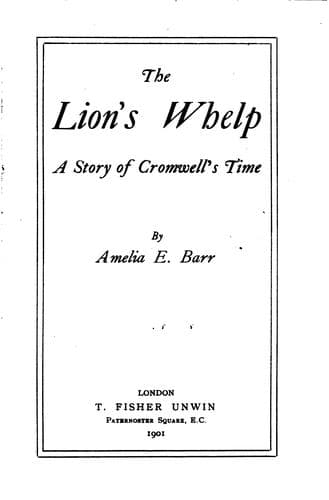
The Lion's Whelp: A Story of Cromwell's TimeBarr, Amelia E.
History
The Lion's Whelp: A Story of Cromwell's Time
Barr, Amelia E.
Great Britain -- History -- Stuarts, 1603-1714 -- Fiction
"It is a stress bound all round by kindness. I heard my father speak of
it. When the de Wick estate was under the Parliament’s consideration,
Cromwell was much disturbed. Your two brothers had just been killed in
battle, your mother was very ill, your father suffering from a severe
wound, and it was the Lord General who wrote your father a letter which
should be graven upon the hearts of every de Wick. In it he promised
that for their old friendship’s sake, and for the sake of the fight over
the Bedford Level—in which fight de Wick stood boldly with Cromwell—that
he would stand between de Wick and all bills of forfeiture. He said also
that he would not hold your father accountable for the acts of his son
Stephen, if he personally restrained himself from all designs and acts
injurious to the Commonwealth. My father said it was such a noble
letter as one brother might have written to another."
"I have heard enough of it. I do not think much of a kindness cribbed
and tethered by this and that condition. It has made my father nothing
but Cromwell’s servant. I am ashamed of it."
"Dr. Verity has been here," said Jane, trying to change the subject.
"Pray, who does not know that? He never comes but he takes some one
away for Cromwell. I thought I could have counted on Acton and Fermor
remaining at home."
"He thinks the war nearly over, Matilda."
"It is not. Even if King Charles were killed, there would then be King
James to fight. The war may last for a century. And if this is the
world, I would I were out of it. Dear, shall I ever be happy again?"
"Yes indeed, Matilda. You will yet be very happy, and forget this
sorrowful time."
"Not while my life lasts, Jane. Trust me, I shall never forget it."
"Let us stop talking of it. At any rate we can do that. Tell me about
your lovers, Matilda. How many have you at this present?"
"The war has taken them all but young Godschall, and he and I are no
longer friends. When he was at de Wick last, we said so much we have
not spoken a word since."
"I am sorry for it."
"’Tis a common occurrence, many women endure it."
"And what has come to George St. Amand? He was once very much your
servant."
"Poor George!"
"Why do you say ’poor George’?"
"Because we are told that all titles are to be cancelled and abolished,
and George St. Amand is dumb unless he can salt every sentence he utters
with what ’my Lord, my father’ thinks or says."
"And there was also among your servants, one Philip Heneage."
"Philip has gone to the enemy. I do not know, and I will not know, and
I scorn to know, anything more about him. He should be hanged, and
cheap at that."
Before Jane could answer, Mrs. Swaffham, who had left the room, returned
to it. She had a hot wine posset in her hand and a fresh Queen’s cake.
"Come, my dearie, and eat and drink," she said. "Keep your stomach in a
good temper, and I’ll be bound it will help you to bear heart-trouble,
of all kinds, wonderfully."
Public-domain text, read in full here on John Shaqi.
Reviews
Reviews
No reviews yet
Be the first to share your thoughts on this work.
Join the Discussion
Join the discussion
Sign in to leave a comment or review.
Sign InorCreate an account