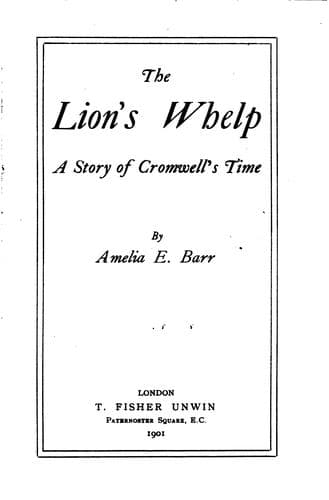
The Lion's Whelp: A Story of Cromwell's TimeBarr, Amelia E.
History
The Lion's Whelp: A Story of Cromwell's Time
Barr, Amelia E.
Great Britain -- History -- Stuarts, 1603-1714 -- Fiction
As she spoke, Mrs. Swaffham hastily entered the room, and with her was
Lord Cluny Neville. Both girls turned from the window and caught his
eyes at the same moment. He was, as Dr. Verity said, a man destined to
captivate, not only by his noble bearing and handsome face, but also by
such an indescribable charm of manner as opened the door of every heart
to him. He carried his morion in his left hand, and in his dress of
dark cloth and bright steel looked the very picture of a Puritan
paladin. Bowing to both girls, he presented Jane with a letter from her
friend Mary Cromwell, and also with a small parcel which contained some
beautiful ribbons. The pretty gift made a pleasant introduction to a
conversation full of gay inquiries and interesting items of social
information. Matilda took little part in it. She watched the young
soldier with eyes full of interest, and did not refuse his escort to her
carriage; but as she departed, she gave Jane one look which left her
with an unhappy question in her heart, not only for that night, but to
be recalled long after as premonitory and prophetic.
During the preparations for the evening meal, and while Neville was in
his chamber removing his armour and refreshing his clothing, Jane also
found time to put on a pretty evening gown. It was of pale brown
lutestring, a little lighter and brighter in colour than her own hair,
and with its stomacher and collar of white lace it added greatly to the
beauty of her appearance. Something had happened to Jane; she was in a
delicious anticipation, and she could not keep the handsome stranger out
of her consideration. There was a brilliant light in her eyes, and a
brilliant colour on her cheeks, and a happy smile on her lovely
bow-shaped mouth.
When she heard Neville’s steady, swift step coming towards her, she
trembled. Why? She did not ask herself, and her soul did not tell her.
It indeed warned her, either of joy or of sorrow, for surely its tremor
intimated that the newcomer was to be no mere visitor of passage, no
neutral guest; that perhaps, indeed, he might have entered her home as a
fate, or at least as a messenger of destiny. For who can tell, when a
stranger walks into any life, what his message may be? Bringers of
great tragedies have crossed thresholds with a smile, and many an
unknown enemy has been bidden to the hearth with a welcome.
Public-domain text, read in full here on John Shaqi.
Reviews
Reviews
No reviews yet
Be the first to share your thoughts on this work.
Join the Discussion
Join the discussion
Sign in to leave a comment or review.
Sign InorCreate an account