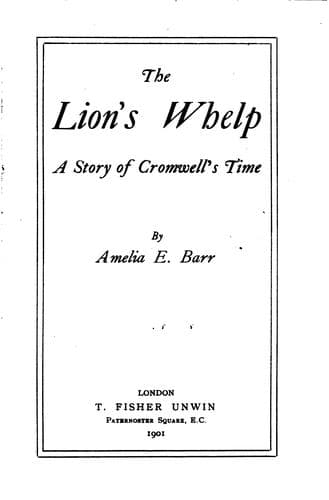
The Lion's Whelp: A Story of Cromwell's TimeBarr, Amelia E.
History
The Lion's Whelp: A Story of Cromwell's Time
Barr, Amelia E.
Great Britain -- History -- Stuarts, 1603-1714 -- Fiction
Then Jane went to her room and began to fold away the pretty things she
had worn the previous night. She smoothed every crease in her silk
gown, and fingered the lace orderly, and folded away her stockings of
clocked silk and her bronzed morocco shoes with their shining silver
buckles. And as she did so, her heart sat so lightly on its temporal
perch that she was singing and did not know it until her mother opened
the door, and like one astonished, asked, "What are you singing, Jane?"
"Why, mother! Nothing but some verses by good George Wither."
Then the mother shut the door again. If George Wither had written what
Jane was singing, she was sure the words were wise and profitable; for
Wither was the poet of the Puritans, and his "_Hallelujah_" all to the
families of the Commonwealth, that the "_Christian Year_" has been to
our own times. So Jane finished without further interruption, but with
rather less spirit her song—"_For Lovers being constrained to be absent
from each other_."
"Dearest fret not, sigh not so,
For it is not time nor place
That can much divide us two;
Though it part us for a space."
And she did not know that, at the very same moment, Cluny Neville was
solacing the loneliness of his ride by the same writer’s "_Hymn for
Victory_" giving to its Hebraic fervour a melodious vigour of
interpretation admirably emphasised by the Gregorian simplicity of the
tune to which was sung—
"It was alone Thy Providence,
Which made us masters of the field.
Thou art our castle of defense,
Our fort, our bulwark, and our shield.
And had not Thou our Captain been,
To lead us on and off again;
This happy day, we had not seen,
But in the bed of death had lain."
*CHAPTER IV*
*SO SWEET A DREAM*
"To judge events, or actions, without connecting them with their causes,
is manifestly unjust and untruthful. Such judgments may make inflexible
justice to appear tyranny; righteous retribution to wear the guise of
cruelty; and virtue itself to have the likeness of vice."
"All love is sweet,
Given or returned. Common as light is love,
And its familiar voice wearies not ever."
Peace was now confidently predicted, but hope outruns events, and the
winter slowly settled down over the level dreariness of the land without
any apparent change in the national situation. People grew tired of
expecting, and turned almost sullenly to the daily duties of life. For
in the North, the winter weather would certainly bring the winter truce,
and they must bear the inaction and suspense as well as they were able.
Public-domain text, read in full here on John Shaqi.
Reviews
Reviews
No reviews yet
Be the first to share your thoughts on this work.
Join the Discussion
Join the discussion
Sign in to leave a comment or review.
Sign InorCreate an account