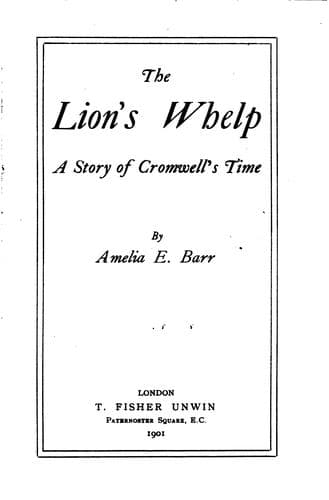
The Lion's Whelp: A Story of Cromwell's TimeBarr, Amelia E.
History
The Lion's Whelp: A Story of Cromwell's Time
Barr, Amelia E.
Great Britain -- History -- Stuarts, 1603-1714 -- Fiction
One day, near Christmas, the roads were hard and clean and the sky blue
above them, and in spite of the cold Matilda resolved to walk over to
Swaffham. She had an abundance of rich clothing, but as she went
through it, she saw that its very splendour was only another sign of her
poverty, for neither her own nor her mother’s wardrobe contained the
plain, scant skirt suitable for walking;—plenty of carriage robes, and
dinner and dancing dresses; plenty of gold and silver tissues, and satin
and velvet, and rich lace, but she would have given the richest of the
costumes for a short cloth skirt and coat, such as Jane trod the miry
ways in with comfort and cleanliness. However, she made the wisest
choice possible, and when she stood before her father drawing on her
white gloves and saying all manner of cheerful words, no one could have
desired any change in her apparel. She held the train of her black
velvet skirt over her left arm; her shoulders were covered with a tippet
of minever, her large hat of black beaver was drooping with plumes. In
her cheeks there was a faint rose colour, and her large brown eyes were
full of feeling. She looked like some lovely princess exiled from her
state and condition, but retaining, nevertheless, all the personal
insignia of her royal birth.
As she left her father she kissed him affectionately, and then curtseyed
to the Chaplain, who did not notice her attention, being happily and
profitably lost in a volume by good Dr. Thomas Fuller, who was that
moment saying to him, in one of his garrison sermons, "A Commonwealth
and a King are no more contrary than the trunk of a tree and the top
branch thereof; there is a republic included in every monarchy."
Matilda walked rapidly, and the clear cold air blew hope and
cheerfulness into her heart. "Perhaps, after all, the King might come
to his own—Cromwell had not reaped all that was anticipated from Dunbar
victory, he was still obliged to remain in Scotland and watch the King;
and if the King’s position needed this watch, there must still be
strength and hope in it. I will take what the Swaffhams say with a
large allowance," she thought; and then she suddenly remembered that
they had had no news from the royalist camp, and knew nothing on which
any good likelihood could be built.
"It is very cruel of Stephen," she sighed; "if I were with the King I
would get word to my father and sister of the King’s condition—but it is
either drawing the sword or shaking the dice, and while they gamble away
the hours and the gold pieces, father and I fret life away in waiting
and watching for the news that never comes."
Public-domain text, read in full here on John Shaqi.
Reviews
Reviews
No reviews yet
Be the first to share your thoughts on this work.
Join the Discussion
Join the discussion
Sign in to leave a comment or review.
Sign InorCreate an account