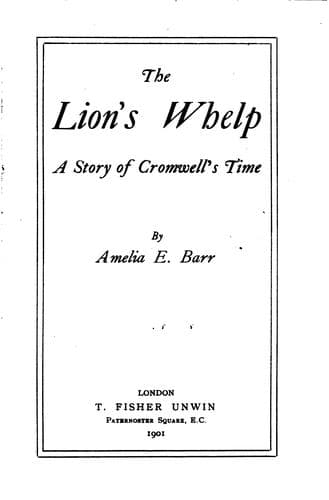
The Lion's Whelp: A Story of Cromwell's TimeBarr, Amelia E.
History
The Lion's Whelp: A Story of Cromwell's Time
Barr, Amelia E.
Great Britain -- History -- Stuarts, 1603-1714 -- Fiction
"We have been talking of fairies, and the gray ghost of Raby, and the
armoured giant that keeps Swaffham portal, and Matilda has told us many
awesome things about Lady Sophia de Wick, whose ring no one can wear and
escape doom."
"Peace to her spirit," ejaculated Mrs. Swaffham, and Jane added
thoughtfully,
"If to such a spirit, peace would be any blessing."
"I would not talk of the dead if I were you; they may be nearer than you
think. And there are wick men and women in plenty to praise and to ban.
Lord Neville has told us nothing at all, yet, about General Cromwell. I
would like to know what is going on. Whatever has he been doing since
Dunbar?"—and Mrs. Swaffham made these remarks and asked these questions
with just a little touch of impatient irritability.
"The first thing he did when he reached Edinburgh," answered Neville,
"was to order the head of Montrose to be taken down from the Tolbooth
and honourably buried. Some of the army grumbled at this order, and the
Scotch whigs preached and raved about it, and even Dr. Verity, it is
said, spoke sharply to Cromwell on the matter. And ’tis also said that
Cromwell answered with some passion, ’I will abide by my order,
notwithstanding the anger of the foolish. We all have infirmities; and
I tell you, if we had among our ranks more such faithful hearts and
brave spirits, they would be a fence around us; for indeed there lives
not a man who can say worse of Montrose than that he loved Charles
Stuart, and was faithful to him unto death.’"
"This is the noblest thing I have heard of Oliver Cromwell," said
Matilda, "and my father will rejoice to hear it. How Montrose loved
Charles Stuart I will tell you, for my brother Stephen was with him when
he heard first of the murder of his King. He bowed his head upon his
sword and wept, and when his heart had found some relief in tears, he
stood up and called the King in a mighty voice,—indeed Stephen told me
it was heard beyond all probability,—and with a great oath he vowed that
he would sing his obsequies with trumpets, and write his epitaph with
swords, in blood and death." As Matilda finished her story, her voice
had a tone of triumph, and she stood up, and raised her eyes, and then
made such a sad, reverent obeisance as she might have done had the dead
been alive and present. No one liked to impugn a ceremony so pathetic
and so hopeless; and a constrained silence followed, which was broken by
Jane asking,
"Where did Charles Stuart go after Dunbar?"
Public-domain text, read in full here on John Shaqi.
Reviews
Reviews
No reviews yet
Be the first to share your thoughts on this work.
Join the Discussion
Join the discussion
Sign in to leave a comment or review.
Sign InorCreate an account