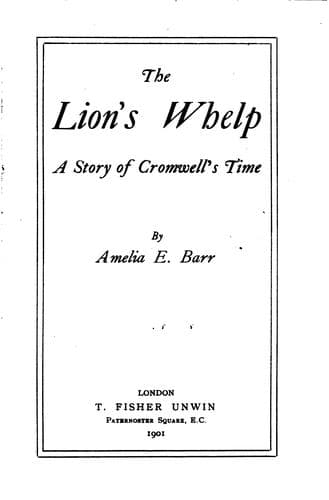
The Lion's Whelp: A Story of Cromwell's Time — John Shaqi
The Lion's Whelp: A Story of Cromwell's TimeBarr, Amelia E.
History
The Lion's Whelp: A Story of Cromwell's Time
Barr, Amelia E.
Great Britain -- History -- Stuarts, 1603-1714 -- Fiction
"That is fortunate," said Matilda. "You know that my father has poor
health, and his liking for study makes him ailing, of late. He sleeps
not. I wish that I had a composing draught for him. Come, Jane, let us
go to the still-room." She spoke with an unconscious air of authority,
and Jane as unconsciously obeyed it, but there was a coldness in her
manner which did not disappear until the royalist lady had talked with
her for half-an-hour about the spices and the distilled waters that were
to prevail against the Earl’s sleeplessness.
When the electuary had been prepared, the girls became silent. They
were as remarkably contrasted as were the tenets, religious and civil,
for which they stood. But if mere physical ascendency could have
dominated Jane Swaffham, she was in its presence. Yet it was not
Matilda, but Jane, who filled the cool, sweet place with a sense of
power not to be disputed. Her pale hair was full of light and life; it
seemed to shine in its waving order and crown-like coil. Her eyes had a
steady glow in their depths that was invincible; her slight form was
proudly poised; her whole manner resolute and a little cold, as of one
who was putting down an offense only half-forgiven.
Matilda was conscious of Jane’s influence, and she called all her own
charms forth to rival it. Putting out of account her beautiful face and
stately figure as not likely to affect Jane, she assumed the manner she
had never known to fail—a manner half-serious and wholly affectionate
and confidential. She knew that Swaffham was always a safe subject, and
that a conversation set to that key went directly to Jane’s heart. So,
turning slowly round to observe everything, she said,
"How cool and sweet is this place, Jane!"
"It is, Matilda. I often think that one might receive angels among
these pure scents."
"Oh, I vow it is the rosemary! Let me put my hands through it," and she
hastily pulled off her white embroidered gloves, and passed her hands,
shining with gems, through the deliciously fragrant green leaves.
"I have a passion for rosemary," she continued. "It always perfigures
good fortune to me. Sometimes if I wake in the night I smell it—I smell
miles of it—and then I know my angel has been to see me, and that some
good thing will tread in her footsteps."
"I ever think of rosemary for burials," said Jane.
"And I for bridals, and for happiness; but it
"’Grows for two ends, it matters not at all,
Be it for bridal, or for burial.’"
"That is true, "answered Jane. "I remember hearing my father say that
when Queen Elizabeth made her joyful entry into London, every one
carried rosemary posies; and that Her Grace kept in her hand, from the
Fleet Bridge to Westminster, a branch of rosemary that had been given
her by a poor old woman."
"That was a queen indeed! Had she reigned this day, there had been no
Cromwell."
Public-domain text, read in full here on John Shaqi.
Reviews
Reviews
No reviews yet
Be the first to share your thoughts on this work.
Join the Discussion
Join the discussion
Sign in to leave a comment or review.
Sign InorCreate an account