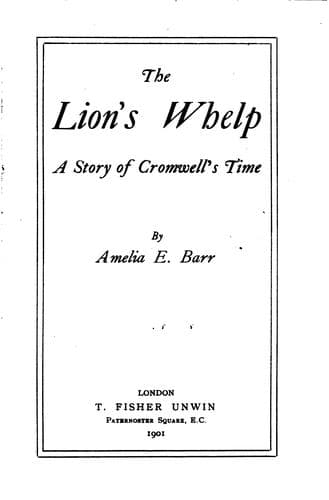
The Lion's Whelp: A Story of Cromwell's TimeBarr, Amelia E.
History
The Lion's Whelp: A Story of Cromwell's Time
Barr, Amelia E.
Great Britain -- History -- Stuarts, 1603-1714 -- Fiction
And Jane smiled and began to talk over with her lover the hard
condition, and somehow it became an easy and reasonable one. They soon
saw it through Love and Hope and Wisdom, and so at the beginning of
their probation, they rejoiced in the end of it. Cluny was hopeful of
getting some military appointment in Edinburgh, and then the estate that
was "no great matter" would be a home, at no inconvenient distance. And
he described the old place with its ivy-covered walls and ancient rooms,
and its garden, dark with foliage, until Jane knew all its beauties and
possibilities. They were so happy and so full of happy plans, that they
were laughing cheerfully together when the General came in with his wife
and household for evening prayers. And it touched and pleased Cluny
that he was mentioned by name in the family petition, and so, as it
were, taken publicly and affectionately into it. He felt this all the
more when the servants, in leaving the room, included him in their
respectful obeisance to their master and mistress. It restored to him
the sense of home, and he carried that strength and joy with him to his
duty, and day by day grew to more perfect manhood in it.
Life soon settled itself to the new conditions of the Swaffhams. The
General, in spite of his wife’s and daughter’s disapproval, bought the
Sandys House near Russel Square, and some of the most precious heirlooms
of old Swaffham were brought up to London to adorn it, For it was now
certain that the Lord General would not agree to part with his faithful
friend and ally; and, indeed, Swaffham’s influence in the army could not
well be spared, for it was evident enough that there was such ill-will
between the army and the Parliament as might easily become a very
dangerous national condition.
"So we may be here the rest of our lives, Jane, and we may as well get
our comforts round us," said Mrs. Swaffham, and there was a tone of fret
in her voice she did not try to hide. "William won’t marry as a good
man should at his age," she continued, "and Tonbert thinks himself too
young to wive; and Cymlin is for Lady Matilda de Wick or no other woman,
and so the dear old place will run to waste and mischief. And there are
the fine milch cows—and the turkeys. Who will attend to them when I am
not there to see they get attention? Nobody."
"Will and Tonbert know how to manage, mother."
"Yes, if it comes to meadow and corn land, or horses, or dogs. I am
thinking of the house and the dairy and the poultry yard. Men don’t
bother themselves about such things; and my boys won’t marry, and my
girls won’t let marrying alone. I am sure I don’t know what to make of
it all."
Public-domain text, read in full here on John Shaqi.
Reviews
Reviews
No reviews yet
Be the first to share your thoughts on this work.
Elsewhere in the archive
Join the Discussion
Join the discussion
Sign in to leave a comment or review.
Sign InorCreate an account