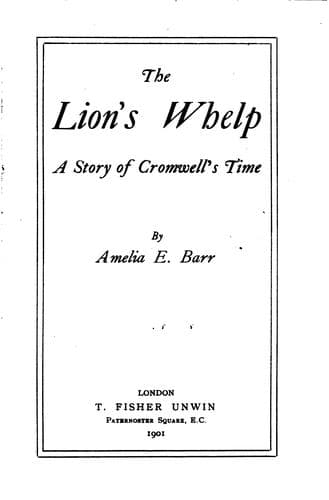
The Lion's Whelp: A Story of Cromwell's TimeBarr, Amelia E.
History
The Lion's Whelp: A Story of Cromwell's Time
Barr, Amelia E.
Great Britain -- History -- Stuarts, 1603-1714 -- Fiction
In spite of her complaining, however, she was well content in London.
Social by nature, fond of the stir and news of life, enjoying even the
shadow of her old friends’ power and splendour, and taking the greatest
interest in all public events of the time, she was pleased rather than
otherwise at the Lord General’s determination to keep her husband near
him.
Neither was Jane at all averse to London. Cluny was in London, and
Matilda was there, and most of the girls whom she had known all her life
long. And it was not difficult to adapt herself to the new home, with
its long galleries and large rooms full of beautiful paintings and
handsome furniture. The little figure in its sober-tinted raiment took
on a prouder poise, richer clothing seemed necessary and fitting; and
insensibly, but continually, the fashion of the Swaffhams’ life shook
off its rusticity and became after the manner of the great Puritan town
in which their lot had been cast.
And if Jane accepted willingly this change in life, Matilda took her
phase of it still more enthusiastically. She was not long in discovering
that it was in her power to be virtual mistress of the Jevery mansion.
Her youth, her beauty and her many sorrows inclined Sir Thomas Jevery’s
heart to sympathy, and this prepossession grew rapidly to devoted
affection. What the Lady Matilda de Wick desired became a law in Jevery
House, and Matilda’s desires were not remarkable for their moderation.
She had her own apartments, her own servants, and her own company at her
own hours, and Sir Thomas settled on her an income which he pretended
had been an agreement between Earl de Wick and himself—a statement
Matilda neither inquired about nor disputed.
No stipulations were made concerning her friends, and indeed Sir Thomas
was not averse to a distinct royalist party in his house, if it was
reasonably prudent. He himself entertained all parties, affecting to be
inclined to men through higher motives than political prejudices.
"Izaak Walton and John Milton, Mr. Evelyn and Sir Harry Vane, are all
equally welcome at my table," he would say; "we have a common ground to
meet on, which is beyond the reach of politics."
So Matilda quickly outgrew those griefs for which there was no remedy;
she regained her health and much of her radiant beauty, and she spent
many hours every day in adorning herself. For the first time in her
life she had money enough to indulge this passion, and Sir Thomas
declared she was in the right to do so. "A lovely woman in a shabby
gown," he said, "is a sin against nature; she is like a queen without
her crown and robes."
With such encouragement to fine attire, Matilda was not sparing in her
orders for silks and brocades, furs and laces, and India goods of all
descriptions. She had inherited her mother’s jewels, and she was
considering one morning a string of Orient pearls, wondering if they
could be worn with her new damasse gown, when Jane entered her
dressing-room.
Public-domain text, read in full here on John Shaqi.
Reviews
Reviews
No reviews yet
Be the first to share your thoughts on this work.
Elsewhere in the archive
Join the Discussion
Join the discussion
Sign in to leave a comment or review.
Sign InorCreate an account