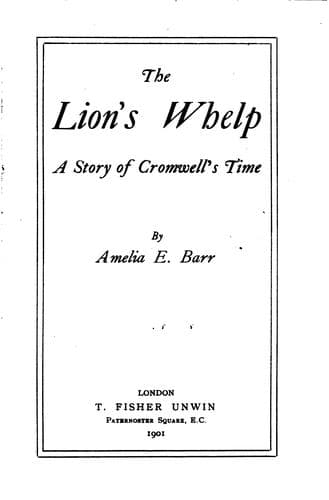
The Lion's Whelp: A Story of Cromwell's TimeBarr, Amelia E.
History
The Lion's Whelp: A Story of Cromwell's Time
Barr, Amelia E.
Great Britain -- History -- Stuarts, 1603-1714 -- Fiction
Matilda did not urge her to remain, and Jane was eager to get away. She
had had some intention—if circumstances favoured the confidence—of
telling Matilda of her betrothal, but the conversation had drifted into
a tone which had made this communication impossible. And she was glad
of her enforced reticence, and resolved to maintain it. She knew, now,
that to make Cluny a topic of conversation was to subject him to
Matilda’s worst words and to all the disagreeable things she could say
in those moods, and she was sure that it would be almost impossible to
keep the peace if Cluny came between them. It was difficult enough to
endure her railing at Cromwell, but if Cluny became the target of her
satire, her annoyances and anxieties, Jane knew that a rupture must
certainly follow.
When she reached home, her father was walking about the parlour and
talking in an excited manner to his wife. He showed much discontent, and
as he walked and talked he rattled his sword ominously to his words.
"Cromwell wants only that Parliament should know its own mind, and
declare itself dissolved. God knows it is high time, but Vane, and more
with him, would sit while life lasts. He said to-day that ’the members
must have their time, and their rights _or_’ and the Lord General took
him up at the word, and answered, ’the army can say "_or_" as loud as
you, Sir Harry, it may be louder,’ and there was a murmur and a noise as
of moving steel. Later, I joined a party in the lobby, and I heard
Colonel Streater say boldly, that in his opinion, Cromwell designed to
set up for himself; and Major General Harrison said, ’You are far
astray, sir; Cromwell’s only aim is to prepare the way for the kingdom
of Christ, and the reign of the Saints;’ and Streater laughed, and
answered with some rudeness, ’Unless Christ come suddenly, He will come
too late.’ Martha, my heart is troubled within me. Have we got rid of
one tyrant calling himself King, to give obedience to a hundred tyrants
calling themselves Parliament? It shall not be so. As the Lord liveth,
verily, it shall not!"
Israel Swaffham’s temper on this matter was but a reflex of the sterner
dissatisfaction which Cromwell voiced for the people. The Parliament
then sitting was the one summoned by King Charles the First, eleven
years previously, and it had long outlived its usefulness. Pym was
dead, Hampden was dead, and it was so shrunken from honour, that in
popular speech it was known as "the Rump" of that great assembly which
had moulded the Commonwealth. It was now attacked by all parties; it was
urged to dissolve itself; yet its most serious occupation seemed to be a
determination to maintain and continue its power.
Public-domain text, read in full here on John Shaqi.
Reviews
Reviews
No reviews yet
Be the first to share your thoughts on this work.
Elsewhere in the archive
Join the Discussion
Join the discussion
Sign in to leave a comment or review.
Sign InorCreate an account