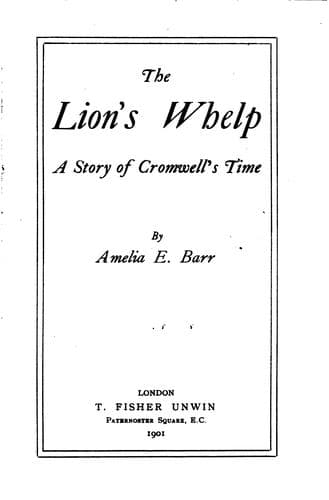
The Lion's Whelp: A Story of Cromwell's TimeBarr, Amelia E.
History
The Lion's Whelp: A Story of Cromwell's Time
Barr, Amelia E.
Great Britain -- History -- Stuarts, 1603-1714 -- Fiction
The leader of these despised legislators was Sir Harry Vane, the only
man living who in Parliamentary ability could claim to be a rival of
Cromwell. But Vane’s great object was to diminish the army, and to
increase the fleet; and as chief Minister of Naval affairs he had
succeeded in passing the Navigation Act, which, by restricting the
importation of foreign goods to English ships, struck a fatal blow at
Dutch Commerce, hitherto controlling the carrying trade. This act was
felt to be a virtual declaration of war, and though negotiations for
peace were going on, English and Dutch sailors were flying red flags,
and fighting each other in the Downs.
Everything relating to the conduct of affairs both in Church and State
was provisional and chaotic; and the condition of religion, law, and all
social matters, filled Cromwell with pity and anger. He wanted the
Amnesty Act, to relieve the conquered royalists, passed at once.
Intensely conservative by nature, he was impatient for the settlement of
the nation, and of some stable form of government. And he had behind
him an army which was the flower of the people,—men who knew themselves
to be the natural leaders of their countrymen,—trained politicians,
unconquered soldiers; the passion, the courage, and the conscience of
England in arms. Their demands were few, but definite, and held with an
intense tenacity. They wanted, first of all, the widest religious
freedom for themselves and others; secondly, an orderly government and
the abolition of all the abuses for which Laud and Charles had died.
And though devoted to their great chief, they longed to return to their
homes and to civil life, therefore they echoed strenuously Cromwell’s
cry for a "speedy settlement," a consummation which the sitting
Parliament was in no hurry to take in hand. On this state of affairs
Cromwell looked with a hot heart. Untiring in patience when things had
to be waited for, he was sudden and impatient when work ought to be
done, and his constant word then was—"without delay."
There was a meeting of the Council at the Speaker’s house the night
after Israel Swaffham’s indignant protest against the Parliament, and
Cromwell, sitting among those self-seeking men, was scornfully angry at
their deliberations. His passion for public and social justice burned
and in a thunderous speech, lit by flashes of blinding wrath, he spoke
out of a full and determined heart. Then he mounted his horse and rode
homeward. It was late, and the city’s ways were dark and still; and as
he mused, he was uplifted by a mystical ecstasy, flowing from an intense
realisation of his personal communion with God.
Public-domain text, read in full here on John Shaqi.
Reviews
Reviews
No reviews yet
Be the first to share your thoughts on this work.
Elsewhere in the archive
Join the Discussion
Join the discussion
Sign in to leave a comment or review.
Sign InorCreate an account