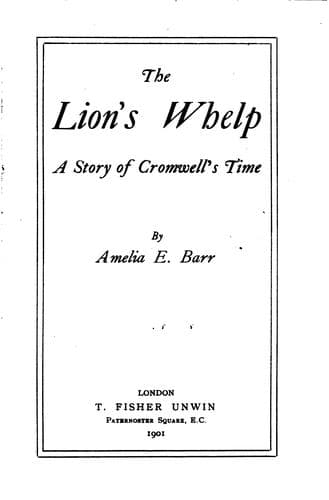
The Lion's Whelp: A Story of Cromwell's TimeBarr, Amelia E.
History
The Lion's Whelp: A Story of Cromwell's Time
Barr, Amelia E.
Great Britain -- History -- Stuarts, 1603-1714 -- Fiction
Cluny Neville was in attendance, and as he silently followed that
dauntless, massive figure, he thought of Theseus and Hercules doing
wonders, because, being sons of Jove, they must of necessity relieve the
oppressed, and help the needy, and comfort the sorrowful; and then he
added to this force the sublime piety of a Hebrew prophet, and in his
heart called Cromwell the Maccabeus of the English Commonwealth. And in
those moments of inspiration, amid the shadows of the starlit night, he
again saw Cromwell grow vague and vast and mythical, and knew that his
gigantic soul would carry England on waves of triumph until she could
look over the great seas and find no rival left upon them.
Thought is transferable, and unconsciously Cluny’s enthusiasm affected
the silent, prayerful man he loved and followed. And so hope came into
Cromwell’s reveries, and many earthly plans and desires; and when he
alighted at Whitehall, he thought instantly of his wife, and longed for
her sympathy. For though he seldom took her counsel, he constantly
looked to her for that fellow-feeling which is as necessary as food.
Man lives not by bread alone, and there is untold strength for him in
womanly love which thinks as he thinks, feels as he feels, and which,
when he is weary and discouraged, restores him to confidence and to
self-appreciation.
He walked rapidly through the silent, darkened rooms, and opening the
door of his own chamber very softly, saw his wife sitting by the fire.
There was no light but its fitful blaze, and the room was large and
sombre with dark furniture and draperies, the only white spots in it
being the linen of the huge bedstead, and the lace coverings of Mrs.
Cromwell’s head and bosom. Yet apart from these objects there was
light, living light, in the woman’s calm, uplifted face, and even in her
hands which were lying stilly upon her black velvet gown. She stood up
as her husband advanced, and waited until he drew her to his heart and
kissed her face. "You are late, Oliver," she said with quiet assertion,
"and I have been a little anxious—your life is so precious, and there
are many that seek it."
"Why do you fret yourself so unwisely? Of a surety you know that I have
a work to do, and I shall not see death until it be finished. Yet I am
greatly troubled for England; I tell you plainly, Elizabeth, that we
are, for all good purposes, without a government."
"There is the Parliament, Oliver."
"I look for no good from it—a noisy, self-opinionated old Parliament.
We want a new one. Vane, and others, think wisdom was born with them;
yea, and that it will die with them. They fritter time away about
trifles, when an Act of Amnesty ought to be passed without delay. It is
the first necessity; they must pass it; they must turn to—or turn out."
"Therein you are right, as you always are."
Public-domain text, read in full here on John Shaqi.
Reviews
Reviews
No reviews yet
Be the first to share your thoughts on this work.
Elsewhere in the archive
Join the Discussion
Join the discussion
Sign in to leave a comment or review.
Sign InorCreate an account