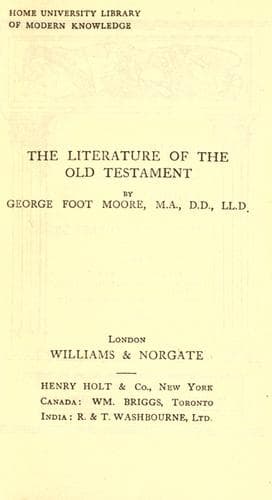
The Literature of the Old TestamentMoore, George Foot
Religion
The Literature of the Old Testament
Moore, George Foot
Bible. Old Testament -- Introductions
MICAH.--The prediction of Micah, the Morashtite, that Zion should be
plowed as a field and Jerusalem be a heap of ruins and the temple hill
become like forest shrines (Mic. iii. 2), is quoted under his name in
Jer. xxvi. 18--the only example of such a prophetic quotation in the
Old Testament. The author, a resident of Moresheth-Gath in the Judæan
Lowland, is said in the title to have prophesied in the days of
Jotham, Ahaz, and Hezekiah, which is the editor's way of saying that
he was a younger contemporary of Isaiah. The reign of Hezekiah is
attested by the tradition in Jeremiah. It is probable that only cc.
1-3 (with perhaps some dubious possibilities in the following
chapters) can be attributed to Micah.
The book opens with an oracle against Samaria (Mic. i. 2-8). Samaria
fell in 721 B.C., while the sequel (vs. 9 ff.) portrays the imminent
peril of Judah, presumably in the time of Sennacherib (701 B.C.). The
case seems to be similar to Isa. xxviii. 1 ff.: the fate of Samaria,
though it is already fact, is represented prophetically for a closer
parallel to the following. Verses 10-16 are little more than a string
of ominous puns on the names of towns in the author's Lowland, which
in translation lose what little point they have. The second chapter
gives the cause of the woe much as in Amos or Isaiah, but perhaps with
local emphasis on the wrongs the capitalists of the great city inflict
on the peasant proprietors. His forebodings and censures are not well
received, men bid him stop his preaching, it is a different sort of
prophet they like (ii. 6-11). "If a man, walking in wind and
falsehood, should lie, 'I will preach to thee of wine and drink,' he
will be the preacher for this people." Micah has more to say, but not
better, about the demagogue prophets in the following oracle (iii.
5-7). The predictions of disaster in ii. 1-11 have their point blunted
in vs. 12 f. in the way the editors of the prophetic books so often do
it.
Chapter 3 returns to condemnation, which turns at last on the heads of
the rulers "who build up Zion with blood and Jerusalem with iniquity,"
and ends with the prediction of the total destruction of the city
which has already been quoted.
Public-domain text, read in full here on John Shaqi.
Reviews
Reviews
No reviews yet
Be the first to share your thoughts on this work.
Elsewhere in the archive
Join the Discussion
Join the discussion
Sign in to leave a comment or review.
Sign InorCreate an account