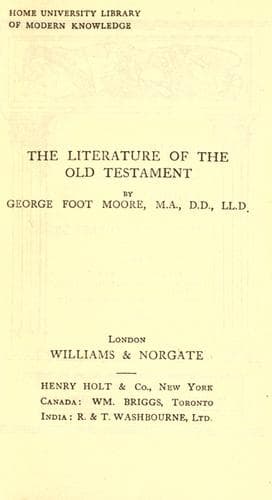
The Literature of the Old TestamentMoore, George Foot
Religion
The Literature of the Old Testament
Moore, George Foot
Bible. Old Testament -- Introductions
Then the unexpected follows, in the prophecy that Jerusalem shall
become the religious centre of the earth, to which all nations flow,
and the law of God the universal arbiter in an age of universal peace
(Mic. iv. 1-5). Verses 1-3 are found also, in no more suitable
context, in Isa. ii. 2-4. They belong to neither Isaiah nor Micah. For
the rest, Mic. 4-5 and cc. 6-7 contain a number of pieces of diverse
age and origin. Chapters iv. 6-v. 1 are as a whole of good omen, yet
after the promise of restoration in iv. 8, Jerusalem is suddenly in
desperate straits; exile awaits its people, and only beyond the exile
(the words "thou shalt come even unto Babylon" may be a gloss, but the
meaning is not essentially changed) redemption waits (iv. 9 f.). In
iv. 11-13, again, many nations gather against Zion, but it crushes
them like sheaves on the threshing floor. There follows (v. 2-9,
10-15) a messianic prophecy, in which an allusion to Isa. vii. 14
appears.
No less strangely assorted are the oracles in Mic. 6-7, of which there
are four: vi. 1-8; vi. 9-16; vii. 1-6; vii. 7-20. The first of these
contains the quintessence of the prophetic conception of religion: God
does not demand holocausts and costly offerings in expiation of sin;
nor the supreme expiation which the prophets and the laws of the
seventh century so often reject and condemn: "Shall I give my
first-born for my transgression, the fruit of my body for the sin of
my soul? He hath showed thee, O man. What is good and what doth God
require of thee, but to do justice and love mercy and walk humbly with
thy God?"
Trenchant condemnations of the sins of the times fill vi. 9-16 and
vii. 1-6, the former of which, at least, is pre-exilic; while the book
closes in the situation and spirit of Isa. 40 ff. Thus the Book of
Micah, like that of his contemporary Isaiah, has been a depository for
prophecies differing in age by several centuries. Perhaps the book
once stood at the end of a roll, and was therefore the natural place
to add stray and nameless pieces, as happened later to the Book of
Zechariah at the end of the volume of the Minor Prophets.
NAHUM.--In the three larger prophetic books we have found groups of
oracles against foreign nations, some relatively old, many late and
literary variations on given motives--it was evidently a grateful
theme. In Nahum we have a whole book occupied with the impending fall
of Nineveh and the Assyrian empire, which had so long and so brutally
tyrannized over all western Asia. Now its hour has struck, and the
prophet triumphs over the fate of the old lion, who "rent in pieces to
satisfy his whelps and strangled for his lionesses, and filled his
dens with prey and his lairs with ravin." His imagination revels in
the terrors of the onslaught, the horrors of the sack, which he
depicts with unsurpassed vividness and great poetic power. It is the
judgment of the Lord, long deferred, but sure and final (Nah. 1).
Public-domain text, read in full here on John Shaqi.
Reviews
Reviews
No reviews yet
Be the first to share your thoughts on this work.
Elsewhere in the archive
Join the Discussion
Join the discussion
Sign in to leave a comment or review.
Sign InorCreate an account