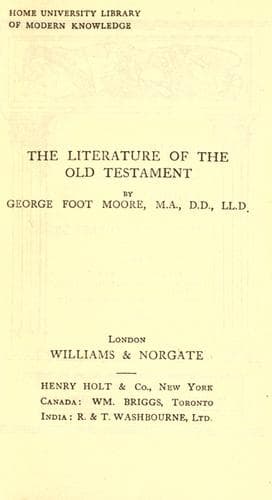
The Literature of the Old TestamentMoore, George Foot
Religion
The Literature of the Old Testament
Moore, George Foot
Bible. Old Testament -- Introductions
MALACHI.--A third appendix to the Book of Zechariah is the anonymous
book which we call Malachi. The earliest title, "The Burden of the
Word of the Lord against Israel," is word for word the same as that in
Zech. xii. 1 (cf. ix. 1), and doubtless was prefixed by the same
editor. Subsequently, perhaps to give the book an independent status
and thus round out the number of the Minor Prophets to twelve, the
words "by 'My Messenger'" (Heb. _malaki_; iii. 1 f.) were added.
Jewish tradition in later times identified this messenger with Ezra.
In the versions the word was naturally taken for a proper name.
The book consists of two parts, Mal. i. 2-ii. 9, which from i. 6 on is
addressed to the priests, and ii. 10-iv. 3, to the people at large.
The priests treat the worship in the temple with professional
disrespect, under which lurks an equally professional scepticism. Any
kind of blemished or diseased victim is good enough--the prophet
invites them to make such a scurvy gift to the governor! The perpetual
routine of sacred services they find tiresome. They are no less
negligent in their other great function as the religious teachers and
guides of the people. The _Tora_, that is, the revealed will of God,
is committed to them, and they, degenerate successors of the faithful
priests in the good old times, have not only themselves abandoned the
right way, but have caused many to fall by their false instructions.
They have earned the contempt in which men hold them. The curse of God
is on them.
One of the most notable words in the Bible stands in this indignant
denunciation (Mal. i. 11 f.). Jehovah's own priests in his own temple
treat his worship with contempt; he refuses their offerings: "For from
the rising of the sun to the setting, my name is great among the
nations, and in every place pure sacrifices are burnt to my name among
the nations, saith Jehovah of Hosts; but _ye_ profane it by thinking
that the table of Jehovah may be polluted and his food despised." That
the sacrifices of the heathen may be "pure" sacrifices, though not
according to the Mosaic rite, because all true worship is the worship
of the true God, is a conception quite unparalleled in the Old
Testament. The author's polemic against the priests of Jerusalem has
doubtless made him say more than he would have stood by as a dogmatic
statement; more, indeed, than any church has ever been ready to
acknowledge, but it was fitting that it should be said, for it is the
final consequence of the ethical conception of religion of which the
Hebrew prophets from Amos on are the exponents.
Public-domain text, read in full here on John Shaqi.
Reviews
Reviews
No reviews yet
Be the first to share your thoughts on this work.
Elsewhere in the archive
Join the Discussion
Join the discussion
Sign in to leave a comment or review.
Sign InorCreate an account