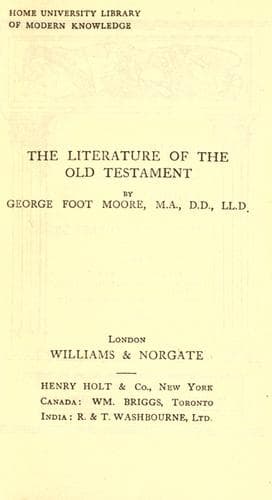
The Literature of the Old TestamentMoore, George Foot
Religion
The Literature of the Old Testament
Moore, George Foot
Bible. Old Testament -- Introductions
Of the remaining oracles, one (Mal. iii. 6-12) urges to the honest
consecration of the tithes (dues to the temple); another (ii. 10-16),
as commonly interpreted, condemns the marriages with heathen women
which so disturbed the soul of Nehemiah and Ezra, and especially the
divorce of native wives to take foreign ones; but the language should
perhaps rather be taken as figurative for foreign worship. The two
remaining prophecies (ii. 17-iii. 5; iii. 13-iv. 3) are addressed to
such as thought that God did not trouble himself about men's affairs:
the long threatened day of doom gave no sign of coming, nor was the
promised reward of serving God bestowed. The prophet declares that the
Day will come, sudden and terrible, and the ungodly will get their
deserts. The last verses (iv. 4-6) are not improbably an addition by
an editorial hand.
CHAPTER XXI
PSALMS. LAMENTATIONS
The Book of Psalms counts one hundred and fifty hymns, and this
evidently by design, for the Greek Version, which sometimes unites in
one what are two psalms in the Hebrew and divides one Hebrew psalm
into two, comes out with the same number. It is divided into five
books, as is indicated in the Revised English Version, vis. Book I.,
Pss. 1-41; Book II., Pss. 42-72; Book III., Pss. 73-89; Book IV., Pss.
90-106; Book V., Pss. 107-150, each book ending with a liturgical
doxology. The rabbis were probably right in the opinion that this
fivefold division was made in imitation of the five books of the
Pentateuch, but in some cases, as we shall see, the limits correspond
to those of older separate books. The psalter has not inaptly been
called the hymn book of the second temple. We learn from Jewish
tradition that certain psalms were used in the liturgy of the
Herodian temple on certain days or at certain seasons, and to many of
them musical or liturgical directions are prefixed and interludes are
noted ("Selah"), from which, apart from tradition, such a use would be
inferred. It is evident from the familiarity with the Psalms which is
shown in the New Testament and in contemporary Jewish writings, both
Greek and Hebrew, that, like our hymn books, the Psalter was largely
used for private devotion and edification.
The poems contained in the Psalter are from different ages and
authors, and of widely diverse religious worth and poetical
excellence. Some of them are unsurpassed in the religious literature
of the world; others are the tedious production of authors who, like
so many hymnists of all climes, were neither born nor made poets.
Thanks to the translators, such pieces are a great deal better, so far
as expression goes, in the Authorized English Version or in Luther's,
than the original.
Public-domain text, read in full here on John Shaqi.
Reviews
Reviews
No reviews yet
Be the first to share your thoughts on this work.
Elsewhere in the archive
Join the Discussion
Join the discussion
Sign in to leave a comment or review.
Sign InorCreate an account