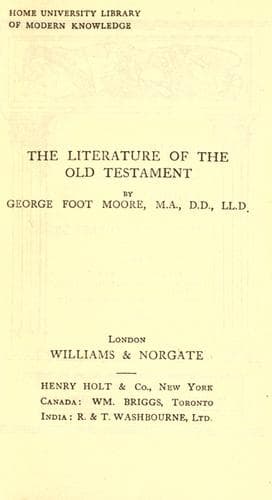
The Literature of the Old TestamentMoore, George Foot
Religion
The Literature of the Old Testament
Moore, George Foot
Bible. Old Testament -- Introductions
A modern hymn book is seldom, if ever, a fresh compilation from the
sources; it is habitually made up from collections already in use,
with the addition, perhaps, of the editor's gleanings from the
sources, or of recent poems. The names of the collections thus used
may be given, and the names of the authors--often taken along without
verification. Editors of hymn books have also generally allowed
themselves great liberties with the text of hymns, altering them to
suit their own taste or the religious and theological idiosyncrasies
of their sect; abridging, transposing, expanding, without scruple; and
only in very modern times has a tardily awakened literary conscience
constrained them to give notice of such changes. In this way mediæval
Catholic poets are made to sing good Protestant songs, or Calvinists
and Methodists to drop their shibboleths and express themselves in a
manner acceptable to Unitarians. The familiar hymn,
"O for a thousand tongues to sing my dear Redeemer's praise,"
has been adapted to Buddhist use as,
"O for a thousand tongues to sing my holy Buddha's praise,
The glories of my teacher great, the triumphs of his grace,"
with similar changes throughout, and if we did not know the Christian
hymn, we might take the author for a good Shin-shu Buddhist, though an
indifferent poet.
The editors of the Psalter proceeded in the same way, and the older
recollections on which they worked can in part be recognized. It is
observed that Books II. and III. of the Psalter (Pss. 42-89), or, more
exactly, Pss. 42-83, must once have formed a collection by themselves,
whose editor was averse to the use of the proper name Jehovah, and
accordingly altered the text of the hymns where this name occurred by
substituting the appellative God (Elohim), giving rise to such strange
expressions as "O God, my God." Thus Ps. 53 is the same with Ps. 14,
but wherever Jehovah stands in Ps. 14, "God" takes its place in Ps.
53; Ps. 70 is merely an extract from Ps. 40 (vss. 13-17) with the same
change. In the latter, however, copyists, influenced by the parallel
passage, have restored "Jehovah" in one (Greek) or two (Hebrew)
places, as they have done in other of these psalms. This occurrence of
the same hymn in two parts of the Psalter, of which another instance
is Ps. 108 (made up of parts of two psalms in the elohistic book,
lvii. 7-11, and lx. 5-12), is itself presumptive evidence that these
parts once existed separately. At the time when the musical directions
were prefixed to the psalms, the last two books (Pss. 90-150) seem not
to have been included in the temple hymn book; for these directions,
scattered through Pss. 1-89, are lacking from that point on,
notwithstanding the fact that a larger proportion of the psalms in
Pss. 90-150 were manifestly composed for public worship than in Pss.
1-89.
Public-domain text, read in full here on John Shaqi.
Reviews
Reviews
No reviews yet
Be the first to share your thoughts on this work.
Elsewhere in the archive
Join the Discussion
Join the discussion
Sign in to leave a comment or review.
Sign InorCreate an account