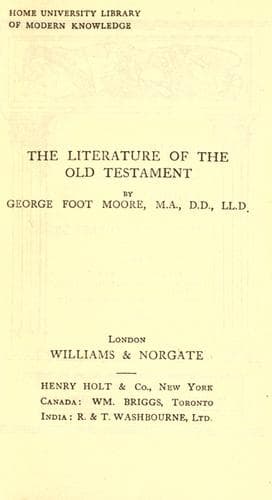
The Literature of the Old TestamentMoore, George Foot
Religion
The Literature of the Old Testament
Moore, George Foot
Bible. Old Testament -- Introductions
That the bulk of this wisdom, when compilation of it came to be made,
should have been labelled Solomonic, is explained by Solomon's fame
for wisdom, which is the subject of numerous anecdotes in the
historical books (see 1 Kings iii. 4-15, with the examples, ibid. vs.
16-28; 1 Kings x. 1-14, etc.), coupled with the explicit statement
that he "spake three thousand proverbs," not to mention his songs and
his expeditions into natural history (1 Kings iv. 29-34). In later
times Solomon's fame for wisdom was not that of an ethical philosopher
but of an adept in magic. It is almost a pity to take away from
Solomon the urgent warnings against women in which the Proverbs
abound; they have in his mouth such a mordant irony.
CHAPTER XXIII
JOB
The Book of Job is the greatest work of Hebrew literature that has
come down to us, and one of the great poetical works of the world's
literature. In the form of a colloquy between Job and his friends, in
which at last God intervenes, it discusses the gravest problem of
theodicy, How can the suffering of a good man be reconciled with the
moral government of God?
In a prose introduction the reader is apprised of the true cause of
Job's sufferings, of which the parties to the colloquy are, of course,
ignorant: they are a trial of his uprightness, more specifically, of
his disinterested virtue. In this "prologue in heaven," Satan insists
that Job's exemplary virtue is no wonder, since God rewards him so
well for it, and God, who has full faith in the patriarch, gives Satan
permission to test him. In an hour all his wealth is swept away and
his children perish, but Job bows submissive to God's will. Then he
himself is smitten with a loathsome and distressful ailment which was
regarded as in a peculiar sense the stroke of God, his wife bids him
"bless" God (a euphemism for "curse") and die; but he rebukes her:
"What? shall we receive good at the hand of God, and shall we not
receive evil? In all this did not Job sin with his lips." His three
friends come to bemoan him and to comfort him, but the sight of his
misery makes them dumb; they sit down with him in silence for seven
days. So far the prologue.
On this scene the poem opens: Job's long suppressed grief breaks out
in bitter words; he curses the day of his birth, he envies the dead
who are at rest. The eldest of the three friends answers him, and so
the colloquy begins. The structure of the poem is symmetrical. Each
friend speaks in turn and to each Job replies. The cycle is thrice
repeated (cc. 4-14; 15-21; 22-26), but, at least in the present text,
the third round is incomplete--Zophar has no speech. The friends being
apparently convinced that it is useless to argue with him, Job
soliloquizes (cc. 27-31), contrasting his former prosperity with his
present adversity, and again protesting his good conscience before God
and men.
Public-domain text, read in full here on John Shaqi.
Reviews
Reviews
No reviews yet
Be the first to share your thoughts on this work.
Elsewhere in the archive
Join the Discussion
Join the discussion
Sign in to leave a comment or review.
Sign InorCreate an account