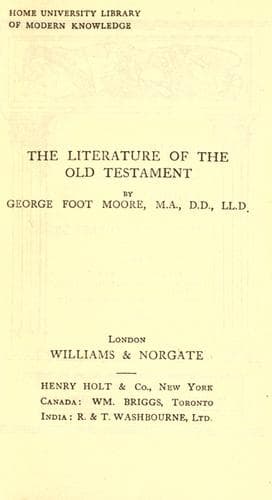
The Literature of the Old TestamentMoore, George Foot
Religion
The Literature of the Old Testament
Moore, George Foot
Bible. Old Testament -- Introductions
Now a new disputant comes on the scene, whose name does not appear
among the dramatis personæ, the youthful Elihu; a short prose
introduction tells us who he is, and why he intrudes. He is incensed
at them all; at Job for justifying himself at God's expense, at the
friends for not having found arguments to put him down. For his part,
he is so full of words that he cannot hold in. He delivers himself,
accordingly, of four speeches (cc. 32 f.; 34; 35; 36), to which Job
vouchsafes no reply.
Suddenly God, whom Job had alternately challenged and implored to
appear, answers him out of the whirlwind (cc. 38-41); with Job's
confession of his presumption in speaking of things he understood not
(xlii. 1-6), the poem ends.
In the prose epilogue God condemns the three friends, whom he pardons
at Job's prayer; and the trial over, God, in poetical justice,
restores Job to a prosperity greater than the first.
In the argument, the three friends and Elihu maintain throughout the
view of divine retribution which was plainly the orthodoxy of the
author's time: God rewards piety and virtue with prosperity and
requites sin with adversity. This law is grounded in the righteousness
of God; it is inconceivable that he should act otherwise.
Consequently if a man is overwhelmed by calamity, as Job is, the only
explanation their religion can allow is that he is a great sinner; any
other interpretation would impugn the justice of God or bring into
question the existence of a divine providence. They recognize, indeed,
that in sending suffering God may design through chastisement or by
way of warning to bring the sinner to repentance and amendment; they
admit that suffering may be a trial of man's faith. They present the
matter to Job thus, especially in their earlier speeches; but the
character of Job's replies convinces them that neither of these is his
case, and they come at last to outspoken accusation.
Job denies their insinuations and their charges. He has done nothing
to deserve such a fate; if they insist on calling this God's justice,
he will say straight in God's face that he is an almighty tyrant, who
unjustly destroys an innocent man. If God slay him for it, he will not
belie his conscious rectitude.
The argument goes round and round, takes this or that turn, grows
hotter as it proceeds, but does not get beyond this deadlock. The
author's motive so far is clear: he means to controvert the dogma that
all suffering, or at least extraordinary suffering, is retributive,
and to show in the instance of Job how this doctrine may drive a godly
man to the denial of God's justice altogether. With remarkable
psychological insight, however, he makes Job not only cling to the
belief that God is more just than his dealings with him show, but
makes this faith grow in even steps with his passionate charges of
injustice. He appeals from the injustice of God to the just God who
some day will have to justify him.
Public-domain text, read in full here on John Shaqi.
Reviews
Reviews
No reviews yet
Be the first to share your thoughts on this work.
Elsewhere in the archive
Join the Discussion
Join the discussion
Sign in to leave a comment or review.
Sign InorCreate an account