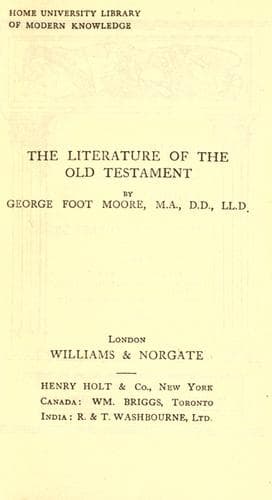
The Literature of the Old TestamentMoore, George Foot
Religion
The Literature of the Old Testament
Moore, George Foot
Bible. Old Testament -- Introductions
The author meant to refute the doctrine that God's providence is
exhaustively explained by distributive justice. Had he his own
solution of the problem of theodicy to put in the place of that cruel
dogma? Job, we have seen, finds no solution. In the speeches of
Jehovah, where dramatic fitness would lead us to look for the author's
solution if he had one, there is no refutation of Job's charges, no
response to his pleadings. The speeches are splendid, but the gist of
them is that God's ways are inscrutable. If man cannot comprehend
God's operations in nature, what folly, what presumption, to pretend
to fathom his dealings in providence! In that Job acquiesces for the
soul of man. Let his sufferings be a mystery, he can submit and trust;
call them punitive, and he revolts against the injustice. That is the
end to which the author would bring his readers. Some one has said
that there is nothing about which men are usually so sure as about the
character of God, and nothing they are so ready to do as to interpret
his dealings by his character--especially his dealings with others.
Such were Job's friends. And from this point of view we have no
difficulty in understanding, what has stumbled some critics, how
they, with their zeal for God's character--that is, for their orthodox
conception of it--come off in the epilogue with so smart a rebuke,
while Job, whose words seemed to them sheer blasphemy, is praised for
saying what was right about God.
The theme of the Book of Job is one which exercised the greatest of
the Greek tragic poets, and it is treated with an Æschylean grandeur;
in conception and execution it declares the genius of its author. It
has not come into our hands altogether as it left his, and certain
parts of the poem are generally recognized as additions by other pens.
Public-domain text, read in full here on John Shaqi.
Reviews
Reviews
No reviews yet
Be the first to share your thoughts on this work.
Elsewhere in the archive
Join the Discussion
Join the discussion
Sign in to leave a comment or review.
Sign InorCreate an account