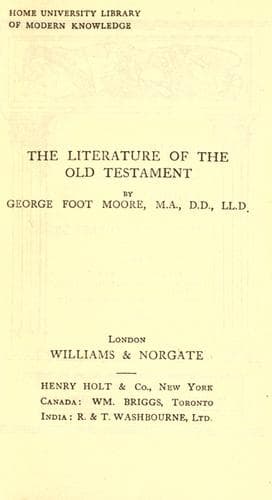
The Literature of the Old TestamentMoore, George Foot
Religion
The Literature of the Old Testament
Moore, George Foot
Bible. Old Testament -- Introductions
The age of the book is determined chiefly by the problem with which it
deals. The doctrine of individual retribution is the application to
the individual of the prophetic teaching about God's dealing with the
nation; it appears in a peculiarly crude and hard form in Ezekiel at
the moment of the break up of the nation. It was furthered by the
teaching of the sages, as in Proverbs, about the connection between
prosperity and happiness and virtue. Experience contradicted the
dogma, and so the problem of theodicy arose--arose in a peculiarly
difficult form, because all that befell a man was attributed to the
immediate act of God, who was not relieved of any part of his
responsibility by talk of second causes and natural laws, and because
the sphere of retribution was limited to this life, with no relief in
the possible compensations of another.
This is the problem of Job, and of itself suffices to put the book in
what is called the post-exilic age. It belongs to the literature of
Jewish Wisdom, with Proverbs and Ecclesiastes. The latter book, one of
the latest certainly in the Old Testament, is much concerned with the
same conflict of dogma with experience, though in a very different
spirit. Job may be a work of the fifth century B.C., or perhaps of
the fourth. The language would incline us to the earlier date.
CHAPTER XXIV
ECCLESIASTES. SONG OF SONGS
Two singular books remain, about the inspiration of both of which the
straitest sect of the Pharisees in the first century of our era had
grave difficulties, Ecclesiastes and the Song of Songs. Both are
attributed to Solomon, the Song by title, Ecclesiastes by implication
in the book itself, and doubtless the supposed authorship had much to
do with finally securing the two books a place in the Jewish Bible.
ECCLESIASTES.--The title of Ecclesiastes runs, "The words of Koheleth
the son of David, king in Jerusalem," under which pseudonym no one but
Solomon can be meant; see also Eccl. i. 12, and especially ii. 1-11.
In the body of the book, Koheleth is regularly used as a proper name;
it is apparently coined for the nonce. Like many pseudonyms in other
literatures, it is probably a mystification, piquant to the author's
contemporaries but impenetrable to us. That it means "Preacher"--an
ancient guess--is highly improbable; but even if the meaning were
transparent, there is no more reason for translating a fictitious
proper name than a real one.
Public-domain text, read in full here on John Shaqi.
Reviews
Reviews
No reviews yet
Be the first to share your thoughts on this work.
Elsewhere in the archive
Join the Discussion
Join the discussion
Sign in to leave a comment or review.
Sign InorCreate an account