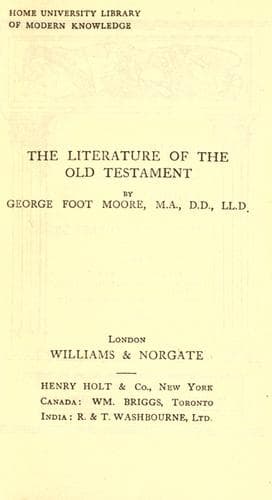
The Literature of the Old TestamentMoore, George Foot
Religion
The Literature of the Old Testament
Moore, George Foot
Bible. Old Testament -- Introductions
The theme of this symphony of pessimism is stridently announced in the
first notes of the overture: "Vanity of vanities, vanity of vanities!
Everything is vanity." The world and its happenings, man and his
strivings, pleasure, pain, wisdom, folly, good and evil--all is
utterly empty; existence has no meaning and no worth. All is chance
and change, in which things endlessly go round and round, but plan,
purpose, progress is nowhere to be seen. And as all have one lot, even
this senseless and inconstant fortune, so death sooner or later
overtakes all alike and ends the strange play without plot we call
human life.
Of a divine providence directed to any end or by any principle, of a
justice above which requites men according to their deeds, long years
and happiness to the wise and good, adversity and premature death to
the wicked and foolish, Koheleth, looking on the world of things as
they are with searching eyes, discovers no sign. Of another world and
an immortal soul, with which some of his contemporaries consoled
themselves, he, keeping his thinking within the bounds of experience,
knows nothing. Man dies as the beast dies, the same vital breath is in
them both, all are of dust and turn to dust again; nor has man any
advantage over the beast, they all have the same end (iii. 19-21; ix.
4-6). There is consolation in this thought, when the misery of the
world weighs too heavy on the heart. The dead are better off than the
living, but happier still it would be never to be born to see the
evils that are under the sun (iv. 2 f.).
When we look the facts squarely in the face, the only counsel of
wisdom is to make the most of what capricious fortune gives us in its
friendly moods, to enjoy the pleasures life offers while we can, with
abandon, but without excess. For the "too much" is always evil, even
too much wisdom and virtue! "Be not over righteous nor put on too much
wisdom, why shouldest thou die before thy time?" (vii. 16 f.).
The author's religion makes God somehow the cause of what happens
under the sun, the evil and the good. In one place he seems to express
the belief that all that God does is fine and opportune, if man could
only understand it; but God has denied man the intelligence to
penetrate the secret of his ways. So there is nothing better for man
to do than to be merry, and have a good time while he is alive!
It is easy to imagine what scandal all this gave to pious souls, and
it was very natural that orthodox editors should try to neutralize
Koheleth's scepticism and his epicurean counsels by notes in an
opposite sense. A modern editor would have put his protests into
footnotes, as for example to Gibbon's famous chapters on the spread of
Christianity; an ancient editor, having no footnotes, put his
incontinently into the text.
Public-domain text, read in full here on John Shaqi.
Reviews
Reviews
No reviews yet
Be the first to share your thoughts on this work.
Elsewhere in the archive
Join the Discussion
Join the discussion
Sign in to leave a comment or review.
Sign InorCreate an account