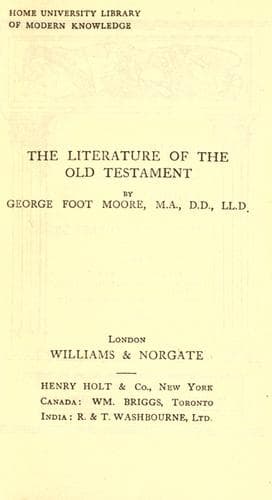
The Literature of the Old TestamentMoore, George Foot
Religion
The Literature of the Old Testament
Moore, George Foot
Bible. Old Testament -- Introductions
In the present volume the results of this critical inquiry are
concisely set forth, with primary reference to the history of the
literature and the development of religion, rather than to the sources
for the political history, a complete investigation of which would
require a somewhat different method. The questions are approached in
the same way in which we should deal with similar questions in any
other literature; critical problems, whether in sacred texts or
profane, can be solved only by the application of the established
methods of historical criticism.
All that survives of Hebrew literature prior to the age of Alexander
is preserved in the Jewish Bible. It is not until the beginning of the
third century B.C. that we come upon books written by Jews in Hebrew
or in Greek which are not included in the canon. It is, doubtless,
only a small part of a rich and varied literature that has thus been
rescued across the centuries; much the larger part of what was written
in the days of the national kingdoms, for example, must have perished
in the catastrophes which befell Israel in the eighth century and
Judah in the beginning of the sixth. What was saved was preserved for
its intrinsic religious value or its association with great names of
religious leaders and teachers, not out of a merely literary or
patriotic interest. Nor were these losses confined to the older
literature. Of the history of Judah under the Persian kings, for
example, there must once have been completer records than the dubious
scraps we have in Ezra. Of secular poetry, which there is every reason
to think flourished no less than hymnody, we should have had no
specimens, had not an anthology of love songs somehow got the name of
Solomon, and by a mystical interpretation been converted to religion.
The remains of this literature are scattered unequally over a period
of a thousand years or more. The youngest writings in the canon date
from the second century B.C. (Daniel, Maccabean Psalms), being later
than Sirach, and contemporary with some of the visions of Enoch. All
that is preserved of the earliest writings has been transmitted to us
by later authors, who incorporated in their works longer or shorter
passages extracted from their predecessors.
Public-domain text, read in full here on John Shaqi.
Reviews
Reviews
No reviews yet
Be the first to share your thoughts on this work.
Join the Discussion
Join the discussion
Sign in to leave a comment or review.
Sign InorCreate an account