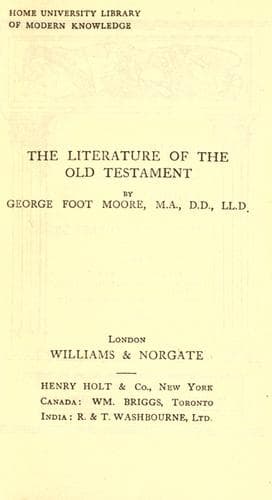
The Literature of the Old TestamentMoore, George Foot
Religion
The Literature of the Old Testament
Moore, George Foot
Bible. Old Testament -- Introductions
It was early observed, however, that there are numerous expressions in
the Pentateuch which assume the settlement of Israel in Canaan and
look back to the age of Moses as to a somewhat remote past: Gen.
xxxvi. 31, for example, implies the existence of the Israelite
monarchy. In the seventeenth century such anachronisms were bandied
about a good deal, but, inasmuch as they were all brief clauses which
might well be notes or glosses by scribes, they proved nothing about
the age of the main text. The controversy sharpened the eyes of the
critics, and many more conclusive facts were brought to light, which
proved that the Pentateuch was not the product of one author nor of
one age, and that, whatever part Moses may be conceived to have had in
it, much must be ascribed to later writers. No methodical attempt had
been made, however, to distinguish its different strata, or to
discover the sources from which it was compiled. This was first
undertaken by an eminent French physician, Jean Astruc, who in 1753
published the results of his investigations under the modest title
"Conjectures concerning the Original Memoirs which it appears that
Moses used in compiling the Book of Genesis." Astruc's analysis was
suggested by peculiar phenomena in the use of the divine names in
Genesis, and he was led to the hypothesis that Moses had for the
primeval and patriarchal history two principal sources, one of which
employed consistently the proper name Jehovah, the other the
appellative Elohim (God). The two narratives were in large part
parallel, and when they were united in one continuous narrative,
repetitions, contradictions, and chronological difficulties were
created which disappear when the sources are separated and recombined
in their original sequence.
This is not the place for a history of criticism: it must suffice to
say that, as the result of the labours of many scholars in the last
century and a half upon the problem of the sources and composition of
the Pentateuch, historians are now generally agreed that four main
sources are to be recognized, of which three run, in varying
proportion, from Genesis to Numbers and reappear in Joshua, while the
fourth is found in Deuteronomy and Joshua only.
CHAPTER IV
CHARACTER OF THE SOURCES: GENESIS
Of the four main sources of the Pentateuch and Joshua, two are easily
recognizable, and may be distinguished with certainty in almost any
combination. The Book of Deuteronomy, though itself a composite work,
constitutes a whole, with a characteristic religious point of view and
marked peculiarities of language and style. The strand akin to it in
Joshua is not always so easy to discriminate from additions and
editorial retouchings in one of the other sources; but since these are
of approximately the same age, the difficulty is, from the historian's
point of view, not of very serious moment.
Public-domain text, read in full here on John Shaqi.
Reviews
Reviews
No reviews yet
Be the first to share your thoughts on this work.
Join the Discussion
Join the discussion
Sign in to leave a comment or review.
Sign InorCreate an account