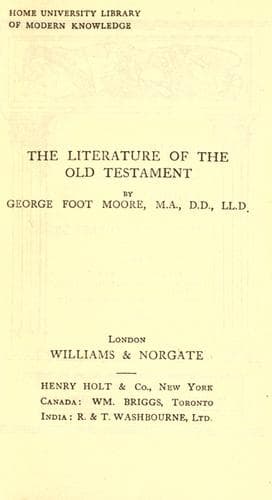
The Literature of the Old TestamentMoore, George Foot
Religion
The Literature of the Old Testament
Moore, George Foot
Bible. Old Testament -- Introductions
A different and much more difficult problem is presented by Jos. 1-12,
the problem, namely, of the sources of the deuteronomist history. The
duplication of the narrative is very plain in the story of Jericho
(Jos. 6). One account told how the Israelites marched around the city
once each day for seven days in ominous silence; on the seventh day,
at Joshua's command, they broke out in the war-cry, and rushing upon
the city from every side, took it by storm, and put every living thing
in it to the sword, sparing only Rahab the harlot and her household.
In the parallel narrative a religious procession, the priests bearing
the ark in the midst, compassed the city seven times; on the last
circuit the priests blew a fanfare on their ram's horns, at which the
walls fell flat to the ground, and the Israelites, after bringing
Rahab to a place of safety, burnt the city with fire. Editors or
scribes who were particularly edified by the horn-blowing start it
prematurely in vs. 8 f., 13, and have tried to improve on the story in
other places. The second version shows the same inclination to glorify
the divine interventions by giving them a magical form which has been
remarked in E's account of the deliverance at the Red Sea, while the
simpler story of the unexpected assault--to which there is a close
parallel in a Roman hand-book of military stratagems--resembles in its
naturalness J's account of the crossing of the sea.
Both sources tell of the rescue of Rahab, and thus presuppose some
such story as we find in Jos. 2, where, again, duplication is evident.
The interdict on the spoils of Jericho (vi. 17, J), is the antecedent
to the story of Achan, whose appropriation of a part of the spoil is
the cause of the repulse at Ai (c. 7), and thus the clues can be
followed backward and forward. The chief source in c. 8 (the taking of
Ai) and c. 9 (ruse of the Gibeonites) also is J, with which the
parallel account of E is combined; additions by later hands are
recognizable, the most remarkable being viii. 30-35 (cf. Deut. xxvii.
1-8, 12). In the history of the two campaigns by which the allied
kings of the south and of the north respectively were annihilated
(Jos. 10 and 11) both sources appear. A considerable part of these
chapters, however, is the work of the deuteronomist author, especially
the summary of the conquests, cc. x. 28-43; xi. 10-23. Chapter 12,
which for completeness goes over the conquests east of the Jordan
also, is dependent on Deut. 3; Jos. xiii. 2-6 (the territories
remaining to be conquered) is of the same sort and probably by the
same hand.
Public-domain text, read in full here on John Shaqi.
Reviews
Reviews
No reviews yet
Be the first to share your thoughts on this work.
Join the Discussion
Join the discussion
Sign in to leave a comment or review.
Sign InorCreate an account