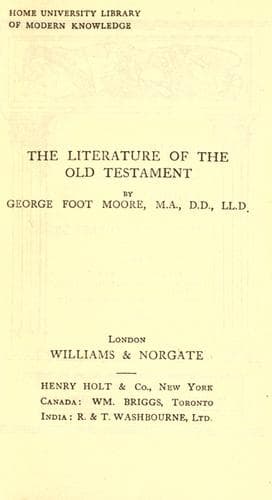
The Literature of the Old TestamentMoore, George Foot
Religion
The Literature of the Old Testament
Moore, George Foot
Bible. Old Testament -- Introductions
The author's source was a collection of stories of struggles in
different parts of the land, both east and west of the Jordan, with
the older settled populations or with invaders, and the exploits of
the leaders and champions of the Israelite tribes in these struggles.
It included Ehud's assassination of the king of Moab, the defeat of
Sisera and the Canaanite kings of the great Plain by Barak and
Deborah, the rout and pursuit of the Midianite invaders by Gideon, and
Jephthah's victory over the Ammonites in Gilead. The history of
Abimelech's kingdom of Shechem--sequel to the story of Gideon--which
is not accompanied by the author's moralizing comments, and the
stories of Samson, which have no more than a chronological
introduction and close, evidently belong to the same cycle of heroic
legends; as do also the stories of Micah's idol and the migration of
the Danites (cc. 17-18), and the older form of the story of the levite
and his concubine and the sanguinary vengeance on Benjamin in cc.
19-21. The two last-named stories were not comprised in the
deuteronomist Judges, whose doctrine they could not well be made to
exemplify. On the other hand we shall see that this work included Eli
and Samuel among the judges, and came to its natural conclusion with
the establishment of the kingdom, as it began with the death of
Joshua.
In several of the stories we recognize not merely such additions and
improvements as are commonly made to popular tales in the retelling,
but evidences of the combination of two versions of the same exploit
or accounts of other doings of the same hero. This is particularly
plain in the story of Gideon, where in Judg. vii. 24 f. (vs. 23 is a
harmonistic note), viii. 1-3, the business of the chiefs of Midian is
effectually finished, while in viii. 4 ff. it is all still to be done.
The phenomenon is entirely similar to those which we have had repeated
occasion to observe in the Pentateuch and Joshua and is to be
explained in the same way. The two versions of the story had been
united before the time of the author of the deuteronomist Judges, for
in the joints of the narrative no trace of his peculiar motives or
style occur.
Public-domain text, read in full here on John Shaqi.
Reviews
Reviews
No reviews yet
Be the first to share your thoughts on this work.
Join the Discussion
Join the discussion
Sign in to leave a comment or review.
Sign InorCreate an account