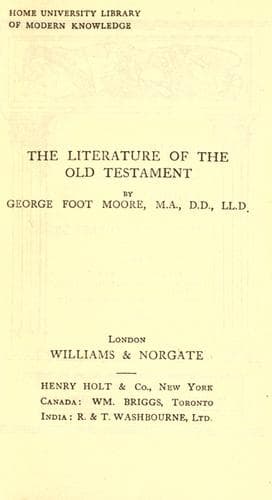
The Literature of the Old TestamentMoore, George Foot
Religion
The Literature of the Old Testament
Moore, George Foot
Bible. Old Testament -- Introductions
The trustworthiness of this picture is confirmed by one contemporary
monument of prime significance, the triumphal ode in Judg. 5, commonly
called the Song of Deborah, celebrating the victory of the Israelite
tribes over Sisera and his hosts and the death of the fleeing king by
the hand of a Bedouin woman in whose tent he sought refuge. The text
in the middle of the poem has suffered greatly, but the beginning and
end are better preserved and display not only a developed poetic art
but poetic inspiration of the highest kind. To the historian it has an
even greater interest for the light which it throws on the times: the
independence of the tribes on both sides of the Jordan, the subjection
of those along the Great Plain to the Canaanite kings with their
walled cities and their formidable chariotry, the summons to the
struggle in the name of religion and the varying response, the victory
of Jehovah over his foes. It should not be overlooked that Judah is
ignored; it was not counted among the tribes of Israel.
The moralizing improvement of the history in the Book of Judges is not
carried beyond the story of Jephthah, but neither at that point nor
after the stories of Samson is there anything to indicate that the
author is done. The introduction in Judg. ii. 11-iii. 6, a passage in
which both the deuteronomist historian and a predecessor in the same
way of thinking have had a hand, seems to require a correspondingly
solemn conclusion, and the example of Deuteronomy and Joshua suggests
that this would take the form of a hortatory address such as Moses and
Joshua deliver as their testament to the people. Exactly such a
discourse is found in 1 Sam. 12, where the aged Samuel, on the point
of laying down his office as judge, reminds the people's conscience of
the chief crises of the times of the judges in terms reminiscent of
the introduction to the Book of Judges and to the several oppressions,
upbraids them for their sin in desiring a king, and closes with
admonitions for the future. Here Samuel appears as a judge, the last
in the succession; as a judge he is represented also in 1 Sam. 7,
where he delivers his people from the Philistines in the great victory
at Ebenezer through the efficacy of his sacrifice and prayers--a
Gideon or a Jephthah went about the business in a more secular
fashion! Eli also is said to have judged Israel forty years. At some
stage in the history of the sources of Judges and Samuel, therefore,
Eli and Samuel were enumerated among the judges, and the close of the
period was marked by the address of Samuel which we now read in 1 Sam.
12. The contents and form of this address have their parallels in the
writings of the sixth century or the latter part of the seventh, and
to that time it is doubtless to be ascribed.
CHAPTER X
SAMUEL
Public-domain text, read in full here on John Shaqi.
Reviews
Reviews
No reviews yet
Be the first to share your thoughts on this work.
Join the Discussion
Join the discussion
Sign in to leave a comment or review.
Sign InorCreate an account