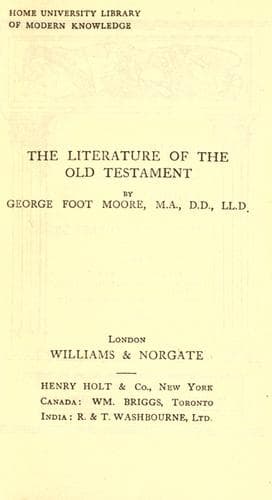
The Literature of the Old TestamentMoore, George Foot
Religion
The Literature of the Old Testament
Moore, George Foot
Bible. Old Testament -- Introductions
Of the two accounts of the origin of the kingdom, it takes no great
critical discernment to see that what we have called the national
version is the older and more historical; the other, which condemns
the monarchy as a kind of apostasy, takes the standpoint of Hosea. The
picture of the monarch in 1 Sam. 12 is drawn from sorry experience.
Even in the older narrative not all is of one piece. Chapter 9, in
which Saul is a young man in his father's house, does not tally with
c. 14, where he has a grown-up son. The author of this narrative made
it up from traditions of diverse origin, some of them more strictly
historical, others embellished with legendary traits. In its main
features, however, it gives us a trustworthy account of the
establishment of the kingdom. In c. 13, the breach with Samuel, vs.
7^b-15^a (with x. 8 which prepares for it), are not part of the
original narrative; c. 15 gives another account of the origin of this
breach, which was evidently a standing feature of tradition. In the
remaining chapters of 1 Samuel the central interest is the relations
of David to Saul. Here also there are not only two main literary
sources but evidence of variant traditions underlying the oldest
narrative, and of the additions by later editors, sometimes of their
conception, sometimes taken from old and good sources.
It is impossible here to pursue the analysis of the sources further.
It must suffice to say that the further on we go, the more the older
and better of the histories predominates. In 2 Samuel almost the whole
is from this source (c. 7 is a notable exception, in the spirit and
manner of the seventh century). Abridgment and transposition have
brought matters into disorder at some points; but 2 Sam. 9-20 is a
well-preserved piece of continuous narrative, of which 1 Kings 1-2 is
the sequel. 2 Sam. xxi. 1-14 and c. 24 are from the same source, but
must originally have stood at an earlier point in the history; their
present position is best explained by supposing that they were once
omitted--which their contents make very natural--and subsequently
restored from a completer copy, not in their proper connection but in
an appendix. Chapter xxiii. 8-39 is a very ancient roster of David's
"valiant men," the companions of his days as an outlawed freebooter on
the Philistine border; xxi. 15-22 is of the same character. Two poems
attributed to David are also included in this appendix, c. 22, which,
with many variants, is found also in the Psalter (Ps. 18), and xxiii.
1-7.
Public-domain text, read in full here on John Shaqi.
Reviews
Reviews
No reviews yet
Be the first to share your thoughts on this work.
Join the Discussion
Join the discussion
Sign in to leave a comment or review.
Sign InorCreate an account