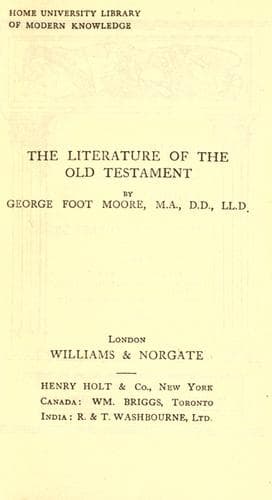
The Literature of the Old TestamentMoore, George Foot
Religion
The Literature of the Old Testament
Moore, George Foot
Bible. Old Testament -- Introductions
The Chronicler names a considerable number of books as authorities for
different periods of the history; the Book of the Kings of Judah and
Israel (or Israel and Judah) and the Book of the Kings of Israel are
repeatedly cited for things not related in our Book of Kings. For more
information about Joash the reader is referred to the "Midrash of the
Book of Kings," and for Abijah to the "Midrash of the Prophet Iddo,"
titles that in later times, at least, would designate an edifying
exposition in which full licence was given to the imagination to
embroider the theme with picturesque inventions. The favourite
references, however, are to writings bearing the names of
prophets--Samuel, Nathan, Gad, Ahijah, Iddo, Shemaiah, Jehu son of
Hanani. The title History of Samuel the Seer, of Nathan the Prophet,
and so on, may mean either _about_ Samuel or _by_ Samuel. Very likely
the author entertained the theory which subsequently prevailed among
the Jews that in each age the prophets wrote down the events of their
own time in which many of them had a conspicuous part.
The question is of no other interest; for an examination of the
extracts from his sources which the Chronicler has incorporated or
condensed shows that (with small possible exceptions to be considered
hereafter) his material was all taken from our Book of Kings. This
enables us to confront his history of Judah with his sources and
acquaint ourselves with his habitual way of dealing with them, an
investigation not only instructive for his method, but of the greatest
importance when we come to the Chronicler's history of the Persian
period, where, for the most part, his sources are not independently
preserved.
In the first place it will be noticed that he has selected from the
history in Samuel and Kings the parts which particularly interested
him for their own sake, such as the description of religious
ceremonies, or could be used as a text for the doctrines he had most
at heart, and has therefore passed over a very large part of the
contents of his source. Precisely so, the author of Kings, two
centuries earlier, had dealt with his sources, though with a different
interest. What the Chronicler chose to include he generally copied out
without much change; the present variations in the text are chiefly
due to divergent transmission. (Compare, for illustration, 1 Chron. x.
1-xi. 47 with 1 Sam. 31 and 2 Sam. xxiii. 8-39, or 1 Chron. xvii.
1-xx. 8 with 2 Sam. 7, 8, 10 and 12.). Often he introduces in these
extracts, or appends to them, notes of his own which would in almost
all cases be certainly recognizable on internal evidence even if we
had not the text of Kings before us. In a few places he condenses or
abridges the narrative of Kings, as in 2 Chron. xxxii. 1-23 compared
with 2 Kings xviii. 13-xix. 37.
Public-domain text, read in full here on John Shaqi.
Reviews
Reviews
No reviews yet
Be the first to share your thoughts on this work.
Elsewhere in the archive
Join the Discussion
Join the discussion
Sign in to leave a comment or review.
Sign InorCreate an account