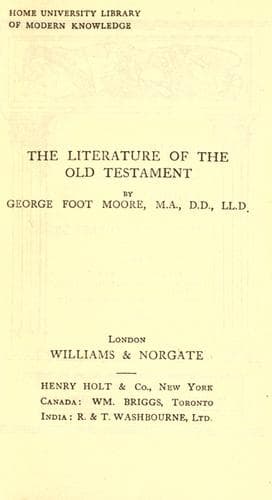
The Literature of the Old TestamentMoore, George Foot
Religion
The Literature of the Old Testament
Moore, George Foot
Bible. Old Testament -- Introductions
Of alterations, or, from the author's own point of view, corrections,
of the older history several examples have been given above. One more,
of a striking character, may be cited, viz. 2 Chron. xxii. 10-xxiii.
21 compared with 2 Kings 11. The Carian mercenaries of the guard in
the sacred precincts of the temple (2 Kings xi. 4) were a plain
profanation, of which the pious chief priest could not have been
guilty. The Chronicler accordingly rewrites the story, substituting
the levites (note 2 Chron. xxiii. 6) for the obnoxious heathen.
Finally, he sometimes freely expands on his text, as in the building
of Solomon's temple (2 Chron. 2-3).
In view of the Chronicler's multiplied references to authorities, it
has frequently been assumed that his immediate source was not the
Books of Samuel and Kings, but a work of a "midrashic" character--that
is, euphemistically, a work with more concern for edification than for
historical verity--written not long before his time from the same
point of view and with the same salient interests, which the
Chronicler in all simplicity took for authentic history. This ghost
source eludes, however, all attempts to catch it actually walking. It
may perfectly well be that the Chronicler did not invent everything in
the book which is plainly invention, but if not, we can only apply the
famous contribution of an undergraduate to Homeric criticism, "the
Iliad was not written by Homer, but by another man of the same name."
There remain a few short notices, not derived from the Pentateuch or
Historical Books, whose contents and form suggest that they are scraps
which the Chronicler picked up from some other source, e.g. the
migration of the Simeonites, 1 Chron. iv. 24-43 (in the main). But
these passages are so few, and generally of so little historical
importance, that the question need here not be pursued farther.
CHAPTER XIII
EZRA AND NEHEMIAH
The books which in our Bible bear the names Ezra and Nehemiah (in the
Jewish Bible, one book, Ezra) are the immediate continuation of
Chronicles, by the same author. When they were divided, 2 Chron.
xxxvi. 22-23, the necessary sequel of vss. 20-21 was repeated at the
beginning of Ezra (Ezra i. 1-3). The reason for the division is plain:
down to the end of the exile the work was no more than an epitome of
the Pentateuch and Historical Books; but from the time of Cyrus to
Alexander it was the only history the Jews possessed. This part was
therefore separated from what went before as the book of post-exilic
history, and named "Ezra" after the figure most prominent in the
earlier half of it, on the same principle that the history of the
founding of the kingdom was named Samuel. The subdivision into two
books of Ezra as in the Greek Bible, or as we name them Ezra and
Nehemiah, is apparently due to Christian hands.
Public-domain text, read in full here on John Shaqi.
Reviews
Reviews
No reviews yet
Be the first to share your thoughts on this work.
Elsewhere in the archive
Join the Discussion
Join the discussion
Sign in to leave a comment or review.
Sign InorCreate an account