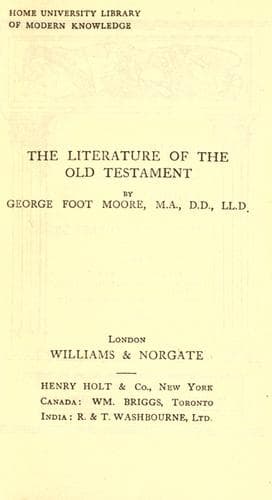
The Literature of the Old TestamentMoore, George Foot
Religion
The Literature of the Old Testament
Moore, George Foot
Bible. Old Testament -- Introductions
Finally, a distinct source is commonly assumed for the history of
Ezra. This is chiefly told of Ezra in the third person; but in some
parts for a considerable space together Ezra speaks in the first
person (I or we), and it is accordingly thought by most scholars that
the Chronicler had in his hands Memoirs of Ezra as well as of
Nehemiah, which in part he incorporated intact (e.g. Ezra 8 f.), in
part recast into the form of a narrative about Ezra (as in Ezra 10;
Neh. 8 f.). It is evident that the story of Ezra, whatever its origin,
is badly dislocated: the chapters which now stand in Neh. 8-10 have no
business there, and, as has been noticed above, in 1 Esdras the
reading of the law immediately follows Ezra 10. On the other hand,
there is a gap at the end of Ezra 6; chapter 9 cannot well be its
original sequel. And, lastly, Neh. 9 f. does not seem naturally to
follow c. 8. The most probable restoration of the order is Ezra 8;
Neh. vii. 70-73; 8; Ezra 9-10; Neh. 9-10. This arrangement gives a
continuous and consistent story, and the numerous dates fall into
sequence. Incidentally another connection is thus restored, Neh. 11
follows vii. 5^a. The list (Neh. vii. 5^b-60) of the exiles who
returned with Zerubbabel and his company ( = Ezra 2) is obviously not
what is required here. The dismemberment of the story of Ezra is not
to be attributed to the Chronicler, but to misadventures of copying
such as are not infrequent in ancient manuscripts.
The extract from the Memoirs of Nehemiah breaks off with Neh. 6;
though perhaps in vii. 1-4; xi. 1-3 the Chronicler has utilized in his
own way some further sentences. In Neh. xii. 27-43, the procession at
the dedication of the walls is described, ostensibly by Nehemiah in
the first person, and the passage has on this ground been taken for an
extract from the Memoirs. It is, however, an unmistakable piece of the
Chronicler's own composition. In c. 13, also, Nehemiah, in the first
person, gives an account of his reforming enterprises on a second
visit to Jerusalem. An unaltered extract from the Memoirs, however,
the chapter cannot well be; the Chronicler's vein crops out in too
many places.
It does not belong to our present task to discuss the historical
value of these sources; but it may not be amiss to say that the
authority of the Memoirs of Nehemiah alone is unimpeached. The
question is of peculiar interest in the case of the supposed Memoirs
of Ezra, because Neh. 8 has been generally understood by recent
critics to be the account of the formal introduction of a new, or
newly codified, law, the Priests' Code or the Pentateuch, which Ezra
brought up from Babylonia.
CHAPTER XIV
STORY BOOKS: ESTHER, RUTH, JONAH
Public-domain text, read in full here on John Shaqi.
Reviews
Reviews
No reviews yet
Be the first to share your thoughts on this work.
Elsewhere in the archive
Join the Discussion
Join the discussion
Sign in to leave a comment or review.
Sign InorCreate an account