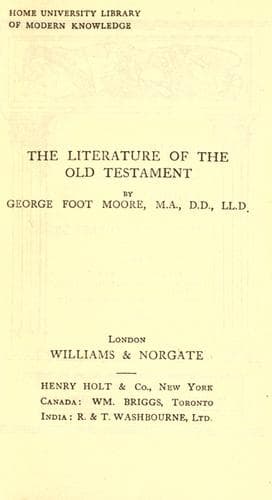
The Literature of the Old TestamentMoore, George Foot
Religion
The Literature of the Old Testament
Moore, George Foot
Bible. Old Testament -- Introductions
Besides the older and younger historical books we have been
considering, the Jewish Bible contains some examples of what we should
call the short story, and the church has preserved others. The
canonical books of this class are Esther, Ruth, and Jonah; among the
apocrypha are Judith and Tobit; others, such as 3 Maccabees, are found
in manuscripts of the Greek and Latin Bibles, or in Oriental
translations, but did not attain official recognition of any of the
great churches. These stories, which, as might be expected, differ
widely in literary quality as well as in subject and motive, are
doubtless only the rare survivors of a larger literature of this kind,
but they suffice to give us a notion of the popular reading of the
Jews in the last centuries before the Christian era. It would be more
exact, perhaps, to say the popular story-telling, for probably the
written books were chiefly used by the story-tellers, who reproduced
their contents orally and freely, just as the Moslem story-tellers
to-day recite stories from the Arabian Nights or the Antar romance.
Some of them, however, like Esther, attached themselves to popular
festivals and were recited or read as part of the celebration.
ESTHER.--Esther is the story of a beautiful Jewess of Susa whom Xerxes
raises from the ranks of his concubines to be his queen, and who uses
her influence over him to save her people from a general massacre
which the grand vizier has prepared for them by way of avenging an
affront from one of the race. The plot is developed with noteworthy
art. The deposition of Vashti, which, so far as the main matter goes,
is necessary only to make room for Esther, under the author's hand
becomes a brilliant first act. The embroilment of Mordecai and Haman
is skilfully managed; the stiffnecked Jew refuses homage to the proud
vizier, who schemes a generous revenge. Esther ventures her life for
her people by intruding into the audience chamber, but the
_dénouement_ is artfully retarded--instead of a pathetic plea for the
imperilled Jews, an invitation for the king and his prime minister to
a _petit dîner_ in the queen's apartments! At the banquet the king
offers Esther her wish, but again the issue is postponed. Haman, in
his elation at such signal marks of queenly favour, builds a gallows
for Mordecai seventy-five feet high--and next day has to parade the
streets of the capital at the bridle of the hated Jew's horse
proclaiming him the object of the king's special honour!
Public-domain text, read in full here on John Shaqi.
Reviews
Reviews
No reviews yet
Be the first to share your thoughts on this work.
Elsewhere in the archive
Join the Discussion
Join the discussion
Sign in to leave a comment or review.
Sign InorCreate an account