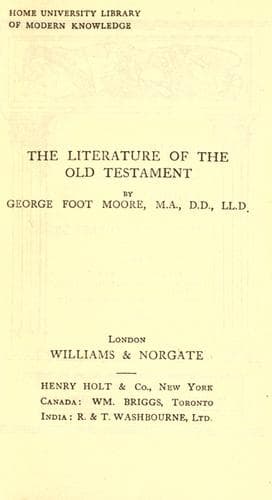
The Literature of the Old TestamentMoore, George Foot
Religion
The Literature of the Old Testament
Moore, George Foot
Bible. Old Testament -- Introductions
It begins with the announcement that the Jews have now been
sufficiently punished for their sins; their guilt has been expiated by
suffering. The hour of national restoration is at hand. God has
already called the deliverer, who will bring low the pride of Babylon
and set free captive Israel; by his edict Jerusalem shall be rebuilt
and the temple restored. The Jews, not only from Babylonia but from
the wide and distant lands of their dispersion, shall flock back to
their own country, the cities of Judah shall be repeopled, and Zion
shall be too strait for its inhabitants. The deliverer is Cyrus (Isa.
xliv. 28; xlv. 1), who is called God's friend, his anointed one
(messiah); the victories he has already gained have been won in the
might of Jehovah, who, all unknown to him, girds him for the battle,
and will go before him to new conquests.
The prophet's prediction was met with incredulity; the power of
Babylon seemed invincible, the resurrection of the dead nation
impossible. Impossible, maybe, to men, but not to the Almighty God,
the creator of heaven and earth, the sovereign ruler of the nations!
As surely as the words of former prophets have come true, so signally
shall these foretellings be fulfilled. For history is the unfolding of
God's plan from the beginning, which he reveals by chapters to his
servants the prophets.
That this prophecy was delivered by Isaiah of Jerusalem, a century
before the fall of Judah and a century and a half before the time of
Cyrus, would never have entered anybody's head had these chapters not
been appended to a roll which bore at its beginning the name of Isaiah
and contained many oracles of the eighth-century prophet. But this
physical fact, which may be due to no intention more profound than a
desire to economize writing material, cannot count against the
conclusive internal evidence; background and foreground in Isa. 40 ff.
are not merely totally different from those of the prophecies of
Isaiah and his contemporaries, they are alike inconceivable in his
age. Nor is the fact that the Jews in New Testament times, including
the New Testament writers, quoted these chapters as Isaiah and
believed him the author of them, prove anything except that such was
the opinion of the Jews in that age.
Public-domain text, read in full here on John Shaqi.
Reviews
Reviews
No reviews yet
Be the first to share your thoughts on this work.
Elsewhere in the archive
Join the Discussion
Join the discussion
Sign in to leave a comment or review.
Sign InorCreate an account