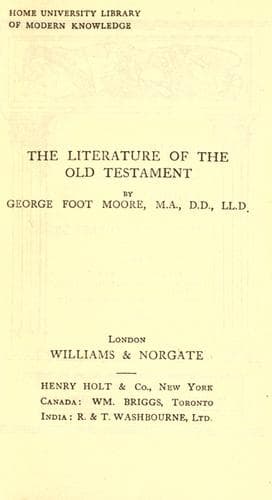
The Literature of the Old TestamentMoore, George Foot
Religion
The Literature of the Old Testament
Moore, George Foot
Bible. Old Testament -- Introductions
The historical situation in Isa. 40 ff. would of itself be conclusive
against Isaiah's authorship; but it is not the only proof of the
contrary. The author of these chapters has not inappropriately been
called the theologian among the prophets. His idea of God is
conspicuously more advanced than that of the prophets of the eighth
century; it lies in the same line with the monotheism of Deuteronomy
and Jeremiah, but lies beyond them. And it is characteristic that, in
contrast to the older prophets, this one reasons about it. He argues
the omnipotence of God in history from his omnipotence in creation,
and makes large use of the evidence from the fulfilment of prophecy to
prove that Jehovah is the only God; he can predict because he
foreordains and brings to pass. With him begins the polemic, not
against the worship of heathen gods, but against their existence. What
the heathen bow down to are naught but helpless, senseless idols, the
work of their own hands. He is fond of inviting his readers to an
image-maker's shop to see how a god is made (see, e.g., Isa. xliv.
9-20). Such are the impotent gods that the Babylonians expect to save
them out of the hands of the creator of the world!
The style of Isa. 40 ff. is not less decisive. Translation necessarily
in large measure effaces the differences, but even in translation a
comparison of two passages on similar themes such as Isa. x. 5-19 and
Isa. 47 may perhaps give some impression of them. The style of Isaiah
and his contemporaries--Amos, Hosea, Micah--is concise and pregnant,
the sentences are short and have often an oracular ring. The author of
Isa. 40 ff. writes with a freer pen in flowing periods; he develops
his thought and his figures more at large; if he is obscure, it is
seldom from compression. Here again, Deuteronomy and Jeremiah, the
whole literature of the seventh century, is an intermediate stage. The
later author is a poet, as Isaiah is, but with other themes and in
other forms; compare, e.g., Isa. 5 with Isa. xlii. 1-9. In short, each
has a highly characteristic style, and the two are totally different.
Public-domain text, read in full here on John Shaqi.
Reviews
Reviews
No reviews yet
Be the first to share your thoughts on this work.
Elsewhere in the archive
Join the Discussion
Join the discussion
Sign in to leave a comment or review.
Sign InorCreate an account