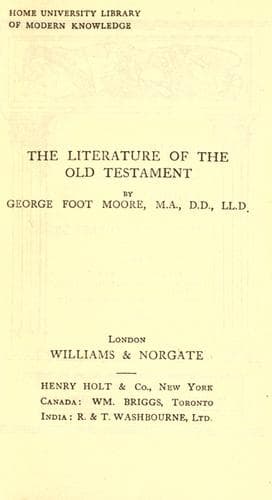
The Literature of the Old TestamentMoore, George Foot
Religion
The Literature of the Old Testament
Moore, George Foot
Bible. Old Testament -- Introductions
The historical situation, as it has been defined above, appears most
distinctly in Isa. 40-55. In the following chapters two passages were
long ago seen not to correspond to that situation, viz. lvi. 9-lvii.
13 and c. 65 (especially vss. 1-16), in which the vehement attack on
idolatrous and abominable rites practised by Jews under the prophet's
eyes was thought to indicate a pre-exilic origin. It was a serious
error, however, to conceive that the so-called exile cured all the
Jews once and for all of every inclination to heathenism; the history
of the Seleucid period sufficiently proves the contrary. There is
nothing in the chapters inconsistent with the view, now generally
entertained, that these flaming denunciations were delivered in
Palestine in the Persian or the Greek period; and there is no warrant
for assuming that they were specifically addressed to the half-heathen
population of the old territory of Israel, still less to the so-called
Samaritan sect, that is, the worshippers at the rival temple on
Gerizim.
Other chapters (Isa. lvii. 14-21; 60; 61 f.) resemble in spirit and
manner the prophecies in Isa. 40-55, but are more probably by later
writers under the influence of those prophecies than by their author.
Their optimism contrasts with the depressed tone of lviii. 1-lix.
15^a, in which the sense of sin is borne in on the community by the
delay in the coming of the good times. In lix. 15^b-21, and lxiii. 1-6
God's fury is poured out on foreign nations, in the latter
specifically on Edom; lxiii. 7-lxiv. 12 is a cry for God's
intervention in dire distress (see lxiii. 18; lxiv. 10 f., devastation
of Judah, burning of the temple); c. 66 contains diverse elements,
consolation to Jerusalem of the school of Isa. 40-45, and censures of
abominable rites (lxvi. 3 f., 17 ff.).
Isaiah 56-66 is, therefore, generally regarded as an appendix to the
book of consolation, cc. 40-55, containing very diverse elements.
It would be nothing strange if alien prophecies and editorial
expansions were found in Isa. 40-55 also, and displacements are
probably in more than one passage. The question of authorship is of
peculiar interest in the case of three prophecies which have for their
subject the mission and suffering of the "Servant of Jehovah," Isa.
xlii. 1-9; xlix. 1-13; lii. 13-liii. 12, which are thought by some to
be taken wholly or in part from an older prophet, by others to be
later insertions. The reasons for ascribing the "Servant" passages to
a different author do not seem decisive.
The Book of Isaiah is thus a great collection of prophecies of various
ages, from the middle of the eighth century B.C. down perhaps to the
third, with some minor additions of even later date.
CHAPTER XVII
JEREMIAH
Public-domain text, read in full here on John Shaqi.
Reviews
Reviews
No reviews yet
Be the first to share your thoughts on this work.
Elsewhere in the archive
Join the Discussion
Join the discussion
Sign in to leave a comment or review.
Sign InorCreate an account