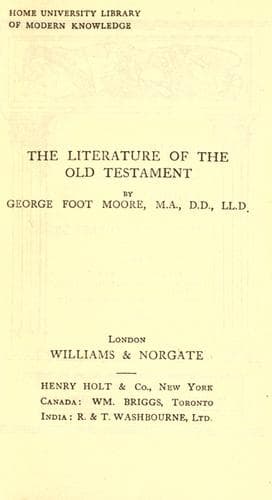
The Literature of the Old TestamentMoore, George Foot
Religion
The Literature of the Old Testament
Moore, George Foot
Bible. Old Testament -- Introductions
Under these circumstances Jeremiah took another way of reaching the
public (see Jer. 36). He dictated to Baruch the prophecies which he
had uttered from the beginning of his mission to that time, and sent
Baruch to read the roll in the temple at the fast in the ninth month
in the fifth year of Jehoiakim (603 B.C.). Some of the nobles had
Baruch give them a private reading, and then carried the book to the
king, first giving Baruch the friendly advice to put himself and
Jeremiah out of harm's way. The king, as he read the roll, cut off the
pages, and burned them on the brazier in his chamber. Jeremiah
thereupon dictated to the faithful Baruch another roll containing all
the prophecies that were in the first, "and there were added besides
unto them many like words." We may be sure that the second edition
would have been even less agreeable reading to Jehoiakim than the
first. One of the additional words is indeed preserved in Jer. xxxvi.
29-31. The chapter is of peculiar interest, because it is an
account--the only one in the Old Testament--of the origin of a
prophetic book. We see the prophet reproducing, doubtless from memory,
the content of oracles uttered in the course of the preceding twenty
years or more, and enlarging the collection for a second edition. It
is a fair conjecture that this second roll furnished to our Book of
Jeremiah most, if not all, the prophecies prior to the fifth year of
Jehoiakim; but it is certain that the roll itself is not incorporated
as such in the present book. There are also several prophecies from
later years of Jehoiakim, and many from the reign of the last king,
Zedekiah, especially from the time of his revolt and the siege of
Jerusalem by the Babylonians.
A distinctive feature of the Book of Jeremiah is the presence of
passages of considerable extent derived from a biographical source.
From this comes the account of the making and reading of the collected
volume of prophecies in the fourth and fifth years of Jehoiakim of
which we have already spoken (Jer. 36), and particularly the narrative
of Jeremiah's fortunes during the last siege of Jerusalem and
afterward, including the flight to Egypt and his experiences with the
refugees there, covering thus three or four years beginning with 588
(Jer. 37-44). To the same source it is natural to ascribe c. 26,
relating to the circumstances and consequences of the prophecy
delivered in the temple at the beginning of Jehoiakim's reign (c. 7);
c. 28 (collision with the "false prophet" Hananiah, in the beginning
of the reign of Zedekiah); c. 29 (letter to the Jews in Babylonia,
about the same time); and parts of cc. 32, 34, and 35.
Public-domain text, read in full here on John Shaqi.
Reviews
Reviews
No reviews yet
Be the first to share your thoughts on this work.
Elsewhere in the archive
Join the Discussion
Join the discussion
Sign in to leave a comment or review.
Sign InorCreate an account