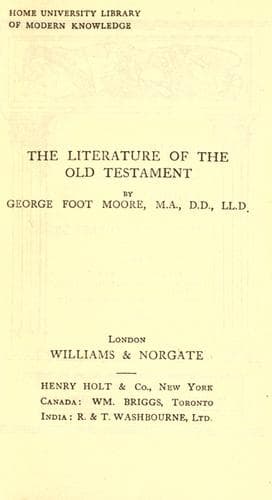
The Literature of the Old TestamentMoore, George Foot
Religion
The Literature of the Old Testament
Moore, George Foot
Bible. Old Testament -- Introductions
There is good reason to believe that the author of this biography was
Baruch, who not only stood in intimate relations with Jeremiah before
the fall of Jerusalem, but accompanied him to Egypt (Jer. xliii. 6).
It is consequently a historical source of the best possible kind. For
the first half of Jeremiah's career this source fails us; and, as we
have seen, it is continuous only from the last years of Zedekiah. It
is possible that Baruch's association with Jeremiah began in the time
of Jehoiakim, and his narrative may have commenced there.
Unfortunately this life of Jeremiah has not been preserved complete or
intact. The prophecies contained in it led later compilers to
introduce other oracles which seemed appropriate to the context, and
to supplement the words of Jeremiah by edifying compositions of their
own. Their aim, it must constantly be borne in mind, was not to
produce a critical edition of the prophecies of Jeremiah, but to make
a book effective to impress the truths and motives of religion on
their own contemporaries, and with changing times and situations to
keep the book, so to speak, up to date. If the words of an old
prophet suggested to them a good moral, they wrote it out for him,
without dreaming that they were doing either him or morality a wrong,
or thinking how much trouble they were making for future historical
students. It is exactly the same procedure and the same motive which
meets us in innumerable places in the Pentateuch and Historical Books.
To stigmatize such interpolations as literary fraud is absurd. These
additions are often recognizable by their prosaic preachiness or by
their composite imitativeness.
Of one kind of prediction the Jews of later centuries could not have
enough, the prophecies of deliverance from the foreign yoke and the
better time to follow. They not only cherished the hopeful words of
former prophets and wrote variations on their themes, but gave
expression to their faith and their ideals in their own way. That they
often took their inspiration from Isa. 40 ff. is natural. In Jeremiah
such promises of a happier future are accumulated in cc. 30-33, which
contain, with some oracles of Jeremiah, pieces of various authorship
and age, some of them such pendants to gloomy pictures as we have
found numerous in Isaiah (e.g. Jer. xxx. 1 ff. to vss. 12-15), others
more independent compositions.
Public-domain text, read in full here on John Shaqi.
Reviews
Reviews
No reviews yet
Be the first to share your thoughts on this work.
Elsewhere in the archive
Join the Discussion
Join the discussion
Sign in to leave a comment or review.
Sign InorCreate an account