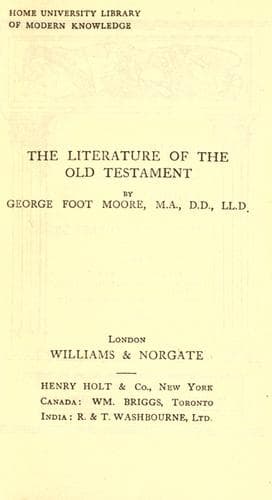
The Literature of the Old TestamentMoore, George Foot
Religion
The Literature of the Old Testament
Moore, George Foot
Bible. Old Testament -- Introductions
Jeremiah's experience in the pursuit of his calling was a hard one.
His Cassandra forebodings gained him the enmity of all, and hostility
grew to bitter hatred as the dire fulfilment stared them in the face.
His countrymen in Anathoth plotted his death; the prophecy in the
temple all but cost him his life, and was an end, for the time at
least, of public appearances; the coming of his collected oracles into
Jehoiakim's hands drove him and the scribe into hiding. During the
last siege, he first was kept in arrest in a private house, then cast
into an empty cistern, where he would have perished but for the
friendliness of a negro eunuch; then confined in the court of the
guard till the taking of the city; released by the Babylonians, his
counsel to the refugees not to flee to Egypt was badly received, and
he was constrained to accompany them. In Egypt, again denouncing and
predicting ill, he disappears; Jewish legend says, killed by his
exasperated countrymen.
But these outward perils and pains were not all he had to bear for
being a prophet. In anguish of soul he suffered twice the tragedy of
his people, in foresight and in fact--suffered as only a man of
sensitive spirit and unflinching will can suffer. That needs no
commentary; but there is another element we do not so easily conceive:
Jeremiah believed that the word of God he had to utter was not merely
a prediction, but the effectual cause, of the ruin of Judah (see Jer.
i. 9 f.). It is not strange that the task God had laid on him seemed
too heavy to be borne. He feels himself a man of contention to the
whole earth. He remonstrates, he reproaches God for having misled him,
he resolves never again to speak in the name of the Lord; but there is
within him as it were a burning fire shut up in his bones, he cannot
hold in (Jer. xx. 7-18; see also xv. 10 f., 15-18; xii. 1-6). These
"confessions," as they have been called, are of the greatest interest;
they are a revelation of the prophet's soul such as has no counterpart
in the Old Testament, and, with Baruch's simple story, bring him as a
man nearer to us than any of the other prophets.
Public-domain text, read in full here on John Shaqi.
Reviews
Reviews
No reviews yet
Be the first to share your thoughts on this work.
Elsewhere in the archive
Join the Discussion
Join the discussion
Sign in to leave a comment or review.
Sign InorCreate an account