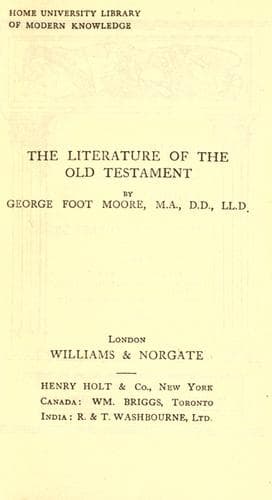
The Literature of the Old TestamentMoore, George Foot
Religion
The Literature of the Old Testament
Moore, George Foot
Bible. Old Testament -- Introductions
In the Hebrew (and therefore in the English) Bible, the last chapters
of the book (Jer. 46-51) contain a collection of prophecies against
foreign nations, to which is appended (c. 52) an extract from the Book
of Kings (2 Kings xxiv. 18-xxv. 21), describing the taking of
Jerusalem by the Babylonian army in 586 B.C. In the Greek Bible the
oracles against the foreign nations come in between Jer. xxv. 13 and
vs. 15, but in an altogether different order. They evidently formed a
little book by themselves, which in one recension of the Book of
Jeremiah were appended to the volume of his prophecies, in another
were inserted in the middle of it as the corresponding collections of
foreign oracles are placed in Ezek. 25-32 and Isa. 13-23. The question
of the original place and disposition of these prophecies is of
importance only for the relation of the two forms of the book to each
other, and need not be pursued here.
It is very doubtful whether Jeremiah had any hand whatever in these
chapters. The prolix prophecy against Babylon (Jer. 50-51) is a purely
literary exercise, for which contributions have been levied right and
left, and was written at a time when Babylon had long ceased to be of
historical importance. Others of the prophecies borrow from earlier
prophets generously. An examination, by the aid of the marginal
references in the Revised Version (Oxford and Cambridge edition,
1898), of the appropriations and reminiscences will give a profitable
notion of this literary imitation of prophecy.
The different order of the prophecies is not the only, nor the most
important, difference between the Hebrew and the Greek Jeremiah.
Besides a great number of variant readings of the ordinary kind, the
oldest Greek version is much shorter than the Hebrew; it has been
reckoned that in the neighbourhood of 2700 words in the latter have
nothing corresponding to them in the translation. Some part of this
may be due to abridgment by the translators, to which the repetitions
in parts of Jeremiah--chiefly secondary parts--invited; but when all
allowance is made for this, it remains that the Hebrew copies from
which the translation was made had a much briefer text than the
Palestinian Hebrew in our hands, and it is probable that the greater
part of this difference, which is chiefly in comparative verbosity, is
due to padding with stock phrases and turns of thought in the
Palestinian text. In some instances oracles or tags to oracles which
on other grounds are recognized as late additions to our text had not
got into that of the Greek translators.
CHAPTER XVIII
EZEKIEL
Public-domain text, read in full here on John Shaqi.
Reviews
Reviews
No reviews yet
Be the first to share your thoughts on this work.
Elsewhere in the archive
Join the Discussion
Join the discussion
Sign in to leave a comment or review.
Sign InorCreate an account