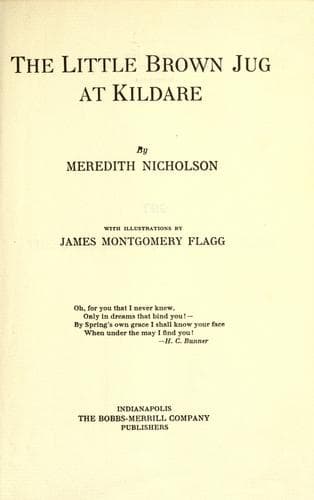
The Little Brown Jug at KildareNicholson, Meredith
General
The Little Brown Jug at Kildare
Nicholson, Meredith
Fathers and daughters -- Fiction; Governors -- Fiction; Humorous stories; North Carolina -- Fiction; South Carolina -- Fiction
When Mr. Thomas Ardmore had read this message half a dozen times with
increasing satisfaction he folded it carefully and put it away in his
pocket-book.
Taking half a sheet of note paper he wrote as follows:
Appleweight and his gang are cowards. Within ten days those that
have not been hanged will be in jail at Kildare.
He studied the phraseology critically and then placed the paper in the
cob stopper whose halves he tied together with a bit of twine. As the
jug stood on the table it was, to all appearances, exactly as it had
been when delivered to Ardmore on the rear of the train at Kildare, and
he was thoroughly well pleased with himself. He changed the blue scarf
with which he had begun the day for one of purple with gold bars, and
walked up the street toward the state house.
This venerable edifice, meekly reposing amid noble trees, struck
agreeably upon Ardmore's fancy. Here was government enthroned in quiet
dignity, as becomes a venerable commonwealth, wearing its years like a
veteran who has known war and tumult, but finds at last tranquillity and
peace. He experienced a feeling of awe, without quite knowing it, as he
strolled up the walk, climbed the steps to the portico and turned to
look back from the shadow of the pillars. He had never but once before
visited an American public building--the New York city hall--and he felt
that now, indeed, he had turned a corner and entered upon a new and
strange world. He had watched army maneuvers abroad with about the same
attention that he gave to a ballet, and with a like feeling of beholding
a show contrived for the amusement of spectators; but there was not even
a policeman here to represent arsenals and bayonets. The only minion of
government in sight was the languid operator of a lawn-mower, which
rattled and hummed cheerily in the shadow of the soldiers' monument.
There was something fine about a people, who, as he learned from the
custodian, would not shake down these historic walls obedient to the
demands of prosperity and growth, but sent increased business to find
lodgment elsewhere. He ascended to the toy-like legislative chambers,
where flags of nation and state hung side by side, and where the very
seats and desks of the law-makers spoke of other times and manners.
Mr. Ardmore, feeling that he should now be about his business, sought
the governor's office, where a secretary, who seemed harassed by the
cares of his position, confirmed Ardmore's knowledge of the governor's
absence.
"I didn't wish to see the governor on business," explained Ardmore
pleasantly, leaning upon his stick with an air of leisure. "He and my
father were old friends, and I always promised my father that I would
never pass through Raleigh without calling on Governor Dangerfield."
"That is too bad," remarked the young man sympathetically, though with a
preoccupation that was eloquent of larger affairs.
"Could you tell me whether any members of the governor's family are at
home?"
Public-domain text, read in full here on John Shaqi.
Reviews
Reviews
No reviews yet
Be the first to share your thoughts on this work.
Join the Discussion
Join the discussion
Sign in to leave a comment or review.
Sign InorCreate an account