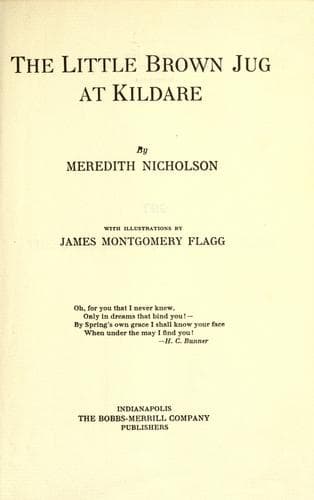
The Little Brown Jug at KildareNicholson, Meredith
General
The Little Brown Jug at Kildare
Nicholson, Meredith
Fathers and daughters -- Fiction; Governors -- Fiction; Humorous stories; North Carolina -- Fiction; South Carolina -- Fiction
"I'll wire you later," replied Ardmore, clinging to his friend's hand a
moment after the train began to move. Griswold leaned out of the
vestibule to wave a last farewell to Ardmore, and something very kind
and gentle and good to see shone in the lawyer's eyes. He went into the
car smiling, for he called Ardmore his best friend, and he was amused by
his last words, which were always Ardmore's last in their partings, and
were followed usually by telegrams about the most preposterous things,
or suggestions for romantic adventures, or some new hypothesis touching
Captain Kidd and his buried treasure. Ardmore never wrote letters; he
always telegraphed, and he enjoyed filing long, mysterious and expensive
messages with telegraph operators in obscure places where a scrupulous
ten words was the frugal limit.
Griswold lighted a cigar and opened the afternoon Atlanta papers in the
smoking compartment. His eye was caught at once by imperative
head-lines. It is not too much to say that the eye of the continent was
arrested that evening by the amazing disclosure, now tardily reaching
the public, that something unusual had occurred at the annual meeting of
the Cotton Planters' Association at New Orleans on the previous day.
Every copy-reader and editor, every paragrapher on every newspaper in
the land had smiled and reached for a fresh pencil as a preliminary
bulletin announced the passing of harsh words between the Governor of
North Carolina and the Governor of South Carolina. It may as well be
acknowledged here that just what really happened at the Cotton Planters'
convention will never be known, for this particular meeting was held
behind closed doors, and as the two governors were honored guests of the
association, no member has ever breathed a word touching an incident
that all most sincerely deplored. Indeed, no hint of it would ever have
reached the public had it not been that both gentlemen hurriedly left
the convention hall, refused to keep their appointments to speak at the
banquet that followed the business meetings, and were reported to have
taken the first trains for their respective capitals. It was whispered
by a few persons that the Governor of South Carolina had taken a fling
at the authenticity of the Mecklenburg Declaration of Independence; it
was rumored in other quarters that the Governor of North Carolina was
the aggressor, he having--it was said--declared that a people (meaning
the freemen of the commonwealth of South Carolina) who were not
intelligent enough to raise their own hay, and who, moreover, bought
that article in Ohio, were not worth the ground necessary for their
decent interment. It is not the purpose of this chronicle either to seek
the truth of what passed between the two governors at New Orleans, or to
discuss the points of history and agriculture raised in the statements
just indicated. As every one knows, the twentieth of May (or was it the
thirty-first!), 1775, is solemnly observed in North Carolina as the day
Public-domain text, read in full here on John Shaqi.
Reviews
Reviews
No reviews yet
Be the first to share your thoughts on this work.
Join the Discussion
Join the discussion
Sign in to leave a comment or review.
Sign InorCreate an account