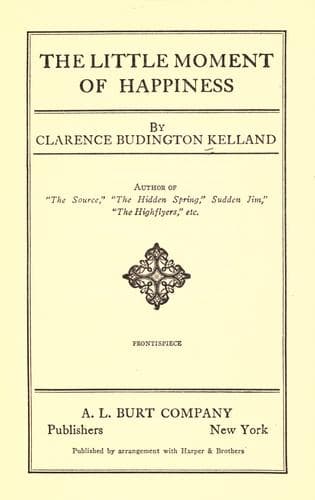
The Little Moment of HappinessKelland, Clarence Budington
General
The Little Moment of Happiness
Kelland, Clarence Budington
Man-woman relationships -- Fiction; World War, 1914-1918 -- Fiction
“But here—with nothing to protect you, without even a decent lock—and
not a woman within half a dozen kilometers!... It isn’t right. They
hadn’t any business sending you to such a place.”
“Rubbish!... I’m safer than I would be in my own home with a policeman
standing in front of the door. Why, I’ve never even thought of being
nervous! Really.... I suppose it is queer.” She stopped a moment to
speculate on its queerness. “If I were back home and somebody should
describe this to me I couldn’t understand any girl doing it.... But I’m
here—and it’s all different.... I never felt so—so _safe_.”
“But an army—even our army—is made up of all sorts of men.”
She laughed with sincerity. “Fiddlesticks!... What do you suppose would
happen to a man who offended me? Why, Kendall”—it was the first time she
had used his given name, but it appeared perfectly natural—“I’ve got a
whole division to look after me.”
It was true. He knew it was true. These American boys—lonely for a
familiar American face, hungry for the sound of the voice and laughter
of an American woman—would idolize her. They would be her slaves.
Safe?... There never had been such safety as was hers—and yet he was
troubled. It was so unconventional—so off the beaten track of the
ordinary movement of life. He did not quite like it.... That was his
mother speaking in him. His mother would have declared such conduct to
be unwomanly, to be not nice, and she would have condemned Maude Knox
unheard.... Because Maude Knox was doing a thing _she_ had never done
and had never seen done by a respectable member of her sex!... Kendall
realized this to be absurd.
“We’re surely in a different world,” he said, tritely.
“The Epworth Sewing Circle wouldn’t approve,” she said, with a twinkle,
“but the Epworth Sewing Circle doesn’t count over here, does it?... I
wonder if it will ever count again anywhere—for us who have been here?”
Kendall wondered, too. What was going to become of the home conventions
when these young women, who had adventured to France to aid as they
found opportunity in the winning of the war, got home? What ideas would
they bring with them and disseminate? What would happen to America?...
America could never be the same, for, not only would these thousands of
girls return, having seen the world with opened eyes—and lived
undreamable lives—but two millions of young men would be going home,
too.... Each one of them would take something of France and of the war
to his home—and what would come of it?...
“You’re—you’re _bully_!” he said, with sudden conviction. “By Jove!
you’re _bully_!”
“Fiddlesticks!”
“What are you here for?... What do you expect to do?”
“Talk, mostly,” she said, merrily. “I guess that’s what I’m wanted for
more than anything else—to let the boys talk to me. Incidentally I’ll
make hot chocolate and sell cigarettes and safety razors and jam and
cookies.... I’ll just be here.”
Public-domain text, read in full here on John Shaqi.
Reviews
Reviews
No reviews yet
Be the first to share your thoughts on this work.
Elsewhere in the archive
Join the Discussion
Join the discussion
Sign in to leave a comment or review.
Sign InorCreate an account