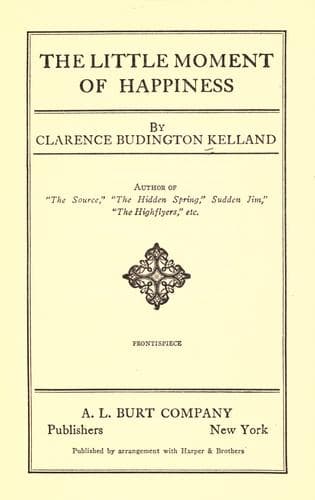
The Little Moment of HappinessKelland, Clarence Budington
General
The Little Moment of Happiness
Kelland, Clarence Budington
Man-woman relationships -- Fiction; World War, 1914-1918 -- Fiction
The effect of the letter upon him, however, had been uncanny. While he
read he was again in Detroit. His sensations were almost exactly those
which he always felt as he entered the Presbyterian church with his
father and mother—not as he sat down in the accustomed pew, but as he
passed through the crowded little vestibule where bald, smug elders and
bearded, smug deacons and severe-faced chairwomen of missionary boards
held their court before the service, shaking hands with all who entered
with that religious affability, that hushed and somber and severe
welcome, which strove to counterfeit open-heartedness.... It was that
vestibule, and not the church, not the sermon, not the hymns nor the
songs, which personified Kendall’s religion and what his religion
meant.... He had grown up among those elders and deacons and chairwomen,
and he knew them—in the church. It was incomprehensible to him that they
could have any interests or activities outside the church. The practice
of religion in that place seemed to him to be the sole occupations of
their lives, and when he met one of them in the secular world of a
week-day in the act of selling goods, or of handling money in a bank, or
of anything else which savored of business and earning a living, Ken had
the sort of feeling one has when he detects a person in something
unusual and a bit discreditable. Why, those persons _were_ the
church!... And the thoughts of those persons were the thoughts of
Kendall’s home world, thoughts among which he had been raised from
babyhood.... So, as he read, he was transported to that vestibule—and
that vestibule’s occupants smugly set the stain of guilt upon him and
rolled eyes of horror at Andree.... He had been seeing Paris with
something that approximated the eyes of Paris—now he was seeing it with
the eyes of the vestibule of the Presbyterian church.
Before him stretched the magnificent avenue, crowded, as dusk descended,
with pleasure-seeking Parisians: he regarded it—regarded it as a
spectator, an utter outsider. It was as if he looked at the scene from a
window in the Presbyterian church. The two worlds stood starkly facing
each other, challenging each other—the civilization that was Paris and
the civilization that had its expression in the occupants of the church
vestibule. Kendall saw, with something very like to fear, that they
could not be reconciled, that neither contained a starting-point which
would lead to understanding of the other.... And yet he, springing from
the one, felt that he understood both. He was drawn to the one while the
other clung to him tenaciously.
Public-domain text, read in full here on John Shaqi.
Reviews
Reviews
No reviews yet
Be the first to share your thoughts on this work.
Elsewhere in the archive
Join the Discussion
Join the discussion
Sign in to leave a comment or review.
Sign InorCreate an account