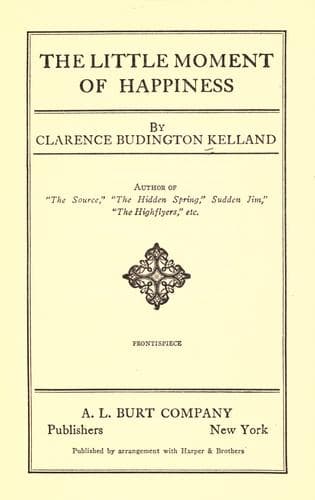
The Little Moment of HappinessKelland, Clarence Budington
General
The Little Moment of Happiness
Kelland, Clarence Budington
Man-woman relationships -- Fiction; World War, 1914-1918 -- Fiction
It was not that his mother’s letter made him feel guilt; it was rather
that it made him feel as if he _ought_ to be conscious of wrong-doing.
He ought to feel wicked and degraded, but he could not, and the fact
that he could not seemed in itself to convict him of sin.... It was only
when he thought of Andree that any semblance of stability came upon his
thinking. There could be no argument about Andree. He had studied her,
known her, loved her—and she was good. No church vestibule, no dogmatic
elder, not even his mother, should say Andree was anything but good. He
got some happiness out of that thought; Andree was an oasis of safety
for him. He was capable of distinguishing between evil and virtue, he
thought, and he had studied Andree as he had never studied any other
living being. From the first moment of their acquaintance he had not
perceived in her one quality, one emotion, one tendency that was not
sweet, womanly, kindly, lovable, springing from a heart of purity....
How could a girl, proved to his intelligence to be good, be otherwise
than good? How was it that any act of hers might be brought into
question? Why was he questioning _his_ righteousness because of his
relations with her when her righteousness because of her relations with
him were not open to question? It was very confusing. Could two
individuals share an act and one of them be good and the other bad
because of it? That sounded like a violation of some natural law as, for
instance, that two solids cannot occupy the same space at the same
instant.... Or was he wholly wrong? Could his judgment of her and of
Paris and of the whole French nation be mistaken?... It might even be
that Paris was not beautiful, as he had seen it beautiful, or that the
French nation was not really sturdy, glowing with virility, heroic, as
its deeds had seemed to prove it to be, but squalid, decadent....
He began to walk rapidly, as was his custom when in mental difficulty,
and as he walked he knew the keen discomfort of a soul in turmoil.... He
tried not to think about it, to put it out of his mind, and to find
pleasure in the evening and in the dusk-softened beauties of the city,
but his mind would not obey. He had a sensation of being terribly awake,
of the blinding glow as of a tremendously powerful white light inside
his head. His thoughts seemed to function independently of him, and
himself to be an audience present to observe and listen to their
activities. There was something ghastly about it, something unreal....
Public-domain text, read in full here on John Shaqi.
Reviews
Reviews
No reviews yet
Be the first to share your thoughts on this work.
Elsewhere in the archive
Join the Discussion
Join the discussion
Sign in to leave a comment or review.
Sign InorCreate an account