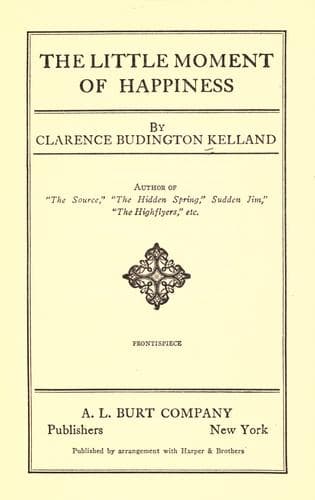
The Little Moment of HappinessKelland, Clarence Budington
General
The Little Moment of Happiness
Kelland, Clarence Budington
Man-woman relationships -- Fiction; World War, 1914-1918 -- Fiction
“Your national _fête_ is but a few days away,” she said. “It is made a
national _fête_ for us also—this fourth day of July. All Paris—all
France will make it a day the like of which has not been seen. I hear
this on all sides.... It is a pleasure to me to have American officers
in this house. I am envied. I speak only the truth. Therefore I hope
messieurs the American officers will procure for me flags of their
country to hang from their windows. It will be an honor. Will messieurs
see to this matter?”
“Yes, indeed,” said Bert. “I’ll get them for you to-day.”
“Many thanks,” she said, and returned to her sweeping.
“Nice old lady,” said Bert. “They’re all nice. Cordial lot—these French
people.... I wonder how we would act in America if we had a couple of
millions of foreign soldiers planted down on us. Mostly we’re
disagreeable to strangers.”
Ken did not answer. He was staring straight before him and thinking,
thinking, thinking. His thoughts were intolerant thoughts, uncharitable,
narrow. It was of thoughts such as his, persisted in until they become
habitual, that are born the hanging of witches and the burning of
martyrs.... They were not natural to him, and they filled him with
discomfort and restlessness. He had a vague sense that he was being not
altogether fair, and that he was condemning the whole because of a fault
in a part. All France must not necessarily be evil because Andree had
proved to be faithless, but he was declaring it to be evil. There was no
good in it; there was no good in anything except the ruthless bigotry
which had taken possession of him. There was no God but Puritanism, and
Narrowness was its prophet....
They reached the Élysées Palace Hotel in which were their offices. He
had not enjoyed his walk; there had been none of that pleasure which
always before he derived from the great open stretches and wide
boulevards of Paris. Beauty had ceased to exist or to signify.... He had
a sensation of being shriveled up and dried—of lifelessness, and his
thoughts seemed to rub against one another like sand-paper.... He saw it
all as the unpleasant process of a moral awakening; it was not that; it
was the disgruntlement of a youth over a love-affair gone awry....
“Hope it wears off during the day,” said Bert.
Ken only grunted, and turned up the stairs.
Public-domain text, read in full here on John Shaqi.
Reviews
Reviews
No reviews yet
Be the first to share your thoughts on this work.
Elsewhere in the archive
Join the Discussion
Join the discussion
Sign in to leave a comment or review.
Sign InorCreate an account