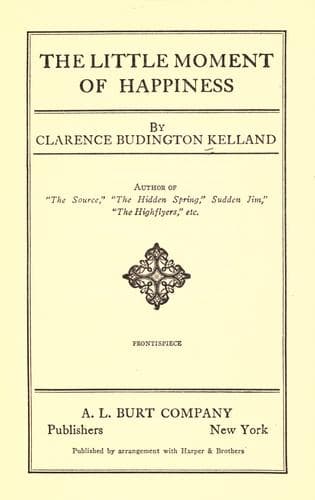
The Little Moment of HappinessKelland, Clarence Budington
General
The Little Moment of Happiness
Kelland, Clarence Budington
Man-woman relationships -- Fiction; World War, 1914-1918 -- Fiction
“I want to see that sort of thing. People have told me that French
family life is beautiful.... One wouldn’t think it to judge from what
we’ve seen.”
“I don’t know about the beautiful,” said Bert, and Ken registered a
thought that Bert would not be likely to notice domestic beauties, “but
there was something fine about it. I liked it.... That old grandmother
was bully. They were all so doggone respectful.... And there was a young
lieutenant, a grandson—had his face shot away. Nothing left but his
mouth and one eye. Wore a big triangular patch over his face. He must
have been quite a fellow, though. Had the Croix de Guerre and the Legion
of Honor and the Médaille Militaire. Just been married, too—to a mighty
nice little girl—one of these home bodies, looked as though. And, by
Jove! she acted like she was a heap in love with him. It sort of got
me—especially when everybody in the room took the opportunity at some
time during the evening to tell me that she never met him until after he
was mutilated.... I don’t believe that sort of girl would pick up with a
fellow, somehow. And I know mighty well her mother and grandmother never
would have. I guess there are all kinds of French people, just the same
as there are Americans....”
“Of course,” said Ken, out of his abysmal ignorance. Then, defensively,
“Maybe these aristocrats are different from the girls we know, but, I
don’t care how they live or how straitlaced they are, they’re no better
than Andree.... Andree’s _good_.”
“Sure,” said Bert, “and you’re dotty.... Meet you at eleven.”
Ken wrote a few letters home, one to his mother in which he went rather
to descriptions and very little to personal matters. He spoke little of
France and the French, but rather made it appear that he was living in a
Paris inhabited exclusively by American soldiers who were all so busy
with the war that they had no time to do anything else but work and
sleep. He did mention seeing Notre Dame ... which was a church, and of
undoubted historic interest. It was a very circumspect letter, and not
at all confidential.... But it is an undoubted fact that mothers and
fathers have to earn by their conduct toward their children those
confidences which they seem to fancy are theirs by right. Ken could have
told his father anything—everything. But his mother—somehow it was
difficult for him to compel himself to make the most trivial disclosure
to her. Her attitude toward him and toward the world had created that
difficulty. The young are naturally confidential....
Then he went to meet Andree.
Public-domain text, read in full here on John Shaqi.
Reviews
Reviews
No reviews yet
Be the first to share your thoughts on this work.
Elsewhere in the archive
Join the Discussion
Join the discussion
Sign in to leave a comment or review.
Sign InorCreate an account