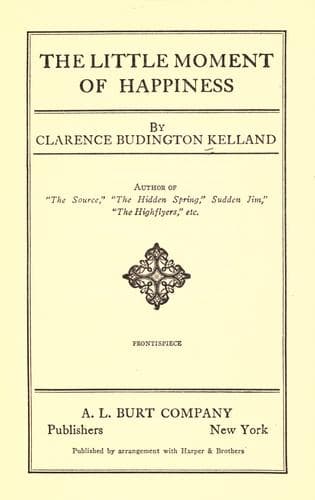
The Little Moment of HappinessKelland, Clarence Budington
General
The Little Moment of Happiness
Kelland, Clarence Budington
Man-woman relationships -- Fiction; World War, 1914-1918 -- Fiction
A hand touched Kendall’s arm and he turned.
“Why, Maude!” he exclaimed, and shot a startled glance toward Andree.
She had not seen, but was peering into her mirror.
“How glad you are to see me!” She laughed. “Really, I’ve nothing
catching. What’s the matter?...” She glanced about and saw Andree. “Oh!”
she said. “I’m glad. I wanted to know her.”
“I told you—” he began; but it was Andree who interrupted.
“_Bon jour_, Mademoiselle Knox,” she said, gravely. “We have met one
little time.”
“Yes, indeed, and I have wanted so much to meet you again. I have told
Mr. Ware....”
“And I, too, have wanted to know you. I have said it to him, yes, many
times. I have said that I shall to know thees Miss Maude Knox—but”—she
shrugged her shoulders—“_les Américains_ are droll.... He would not.”
“He can’t help himself now, can he? Now that we know we want to be
acquainted with each other, there’s nothing he can do about it.”
“Oh, I do not onderstan’. You speak _trop vite, mademoiselle_. My
English it is of the worst.”
“And my French is non-existent. But that doesn’t matter in the least,
does it? We shall get on.”
For those girls there was now something of much greater importance than
the parade, and they promptly forgot it. Maude moved over to Andree’s
side and they began the sort of conversation that women use when they
are appraising each other with serious intention. Ken listened uneasily.
There was nothing he could do. This thing that he had desired not to
happen _had_ happened, and that was all there was to it. He pretended to
watch the parade, but his mind was concentrated on what the girls were
saying. The girls appeared to have forgotten him as well as the marching
men.
Ken was acutely apprehensive, but of what he was apprehensive he did not
know. The thought that Andree and Maude were together, chatting,
becoming acquainted, seemed to him very threatening. He had been in a
holiday humor, but that humor was gone. He frowned and was conscious of
both irritation and depression. It was not right for them to meet.
Something was sure to come of it.
It was not at all that he felt that Andree was not a fit companion for
Maude Knox. That was not it. He was not ashamed of Andree, and,
strangely enough, when one considers his temperament and the hereditary
impulses which stirred within him, he was not ashamed of his relations
with her. It was an intangible apprehension, a feeling that one woman
whom he knew he loved and another woman with whom he might be in love
could not meet without unpleasant results to him.
There was curiosity, too, which grew stronger. More than once he had
compared Andree with Maude Knox when neither was present, but now they
were together, at his side, under his eyes.... He edged away a trifle
with elaborate unconsciousness, and presently reached a point from which
he could study the girls with covert glances.
Public-domain text, read in full here on John Shaqi.
Reviews
Reviews
No reviews yet
Be the first to share your thoughts on this work.
Elsewhere in the archive
Join the Discussion
Join the discussion
Sign in to leave a comment or review.
Sign InorCreate an account