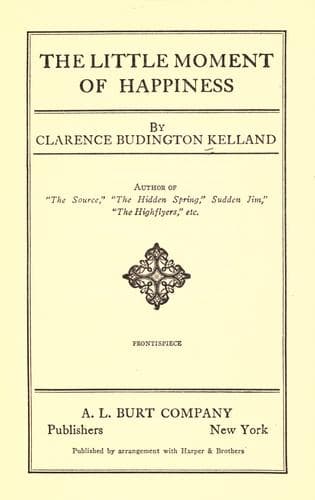
The Little Moment of HappinessKelland, Clarence Budington
General
The Little Moment of Happiness
Kelland, Clarence Budington
Man-woman relationships -- Fiction; World War, 1914-1918 -- Fiction
It was not so much their appearances that he compared as it was their
_selves_ as he knew them, and as they were indicated by what met the
eye. He was trying to arrive at a knowledge of what each girl meant in
his life, what she could contribute to his life. Perhaps this was wholly
selfish, but choice must ever be selfish. It is after choice is made
that one may be generous and self-denying.
The contrast between Andree and Maude was so extreme that they seemed to
have nothing in common but their sex, and as Ken considered he saw they
had not even this in common. At least their conception of it and of its
duties and possibilities and obligations and uses were as different as
the color of their eyes or the expressions of their faces. One could not
see Andree without being conscious that she was a woman, of the
femininity of her, and that the chief business of her life was to be the
complement of some man. The first emotion that Andree excited was
tenderness.... As one looked at Maude Knox his first thought was
comradeship, followed by a mental note that she would be reliable,
capable of taking care of herself. Maude was not beautiful, but she was
pretty, with a clean-cut, boyish prettiness that spoke of health of mind
and of body. She was not the sort a man would fall in love with at first
sight, but rather one who would first be admired and then loved....
Andree would be loved first, then admired as the sweetness of herself
unfolded under the urging of love. Andree was fragile. Ken looked at her
lips, perfectly drawn, delicate, sensitive—her most eloquent feature.
They were lips to kiss, lips to give kisses. There, perhaps, stood the
chief difference between these girls and their attitude toward life:
that Andree would give, give, give—asked no other happiness but to give
of herself and her sweetness and her tenderness and her love—while Maude
would demand an exchange. She, too, could love, but always there would
be inhibitions and reservations. She would take thought of practical
matters, be efficient in love and marriage. Not that she would be
selfish, Ken felt sure, but that she would see to it her relations with
the man she loved would be well organized and stabilized. She would be a
wife and a comrade to the man she married, and perhaps a dominant force;
Andree would be wife and sweetheart, with no thought of dominating, but
only of giving, of adding to the happiness of the man she loved.
Public-domain text, read in full here on John Shaqi.
Reviews
Reviews
No reviews yet
Be the first to share your thoughts on this work.
Elsewhere in the archive
Join the Discussion
Join the discussion
Sign in to leave a comment or review.
Sign InorCreate an account