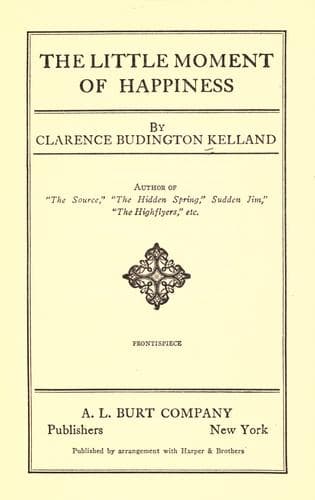
The Little Moment of HappinessKelland, Clarence Budington
General
The Little Moment of Happiness
Kelland, Clarence Budington
Man-woman relationships -- Fiction; World War, 1914-1918 -- Fiction
“And ever’ man ees marry and ees faithful to his wife,” interrupted
Andree, “and all are ver’ _sérieux_ and mos’ religious, and they are
asham’ when they love. I know! I have study monsieur.” She laughed with
childish gaiety. “Oh, mademoiselle, it mus’ be ver’ droll.... Regard
them—they are born, these Americans, they become ver’ rich, they marry,
they die—but they never live. It is that I believe they are afraid to
live....”
“Yes, mademoiselle,” said Maude, “you have hit on something there. We
are afraid to live, all of us. We want to live. We want a great
happiness, but we are afraid of it. You can’t understand us better than
we can understand you.... You have learned to live and be unafraid. We
have not learned to get the best out of life, and our greatest terror is
of our neighbors’ tongues.... It has been wonderful for me to come to
your country and to see....”
“And has mademoiselle really seen?” asked Andree, her eyes on Maude’s
face.
Maude hesitated. “I have tried to see, and I think I have understood a
little. I have changed. I am not the same.... No, I am not the same girl
at all who landed in France a few months ago.”
“May one ask what mademoiselle have see’?”
Maude answered, speaking slowly and feeling her way: “When I left
America I thought I was broad-minded and tolerant. My father had brought
me up to be less narrow-minded than most girls.... He is a professor of
philosophy. But I have found out that I was very narrow-minded indeed. I
could see only one side, and that was the viewpoint of those among whom
I was brought up. The thing I have come to see is that my home town was
right in setting up its own standards and in maintaining them—because
those standards were best for my home town.... But I have found out that
other towns and countries have an equal right to set up their own
standards and arrange their own modes of living. I think I can believe
now that a thing which is very wrong in Terre Haute, Indiana, may be
right in Paris or London or Rome, and that a thing which may be right in
Terre Haute may be wrong in Venice.”
“I onderstan’,” said Andree, gravely. “The theeng you mean to say is
thees, is it not? That an act it become’ wrong when we theenk it is
wrong? But if one city theenk it is right, then it is right for that
city? _N’est-ce pas?_”
“Yes, something very like that.”
“Is that an answer to the question I asked you at dinner a few days
ago?” Ken asked.
Andree looked at him quickly.
Maude paused a moment before she replied; then she shook her head. “No,”
she said, “that is more complex.... If you were a Parisian I think I
could answer, yes, without hesitation. But you are an American, who,
possibly, should cling to American standards, no matter where you find
yourself.... It is different.... No, I don’t know what the answer
is—yet.”
“And thees question?” asked Andree, directly.
Public-domain text, read in full here on John Shaqi.
Reviews
Reviews
No reviews yet
Be the first to share your thoughts on this work.
Elsewhere in the archive
Join the Discussion
Join the discussion
Sign in to leave a comment or review.
Sign InorCreate an account