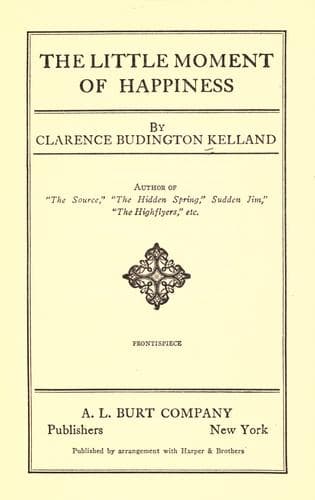
The Little Moment of HappinessKelland, Clarence Budington
General
The Little Moment of Happiness
Kelland, Clarence Budington
Man-woman relationships -- Fiction; World War, 1914-1918 -- Fiction
He said this to himself, and then hotly denied it. She was not bad. In
his heart he knew she was not bad, and he knew as well that he had never
approached a soul which was as clean, as unselfish, as purely tender as
hers.... Maude Knox was good, too, capable of unselfishness and fine
tenderness. But she could never accomplish what Andree had accomplished.
She could never do as Andree did and retain her purity.... He did not
realize that this was because Maude herself would have believed herself
to have lost her purity.
For Kendall the matter marched back to the attitude he had absorbed from
his mother—that relations between the sexes were wicked in themselves
and could never be anything else, but that by some miraculous quality
belonging to a formula pronounced by a parson it became permissible for
designated couples to practise wickedness without fear of punishment.
The wickedness remained, but the formula remitted the punishment. That
was his mother’s belief.... She had been bitterly ashamed when Kendall
became evident, because he was testimony to the world that she had been
guilty....
Ken realized that he was getting himself into a state of mind, that he
was reviving those disturbing thoughts which had such power to make him
miserable ... and he had been very happy with Andree. He had loved his
happiness, and now he wanted it to persist. It had been something new in
his life, very precious, very wonderful ... and he was not willing that
it should be dimmed.
He stepped behind the girls and spoke.
Andree turned and smiled. “You shall go away,” she said. “We do not need
you. You shall watch the parade while Miss Knox and myself make thees
ver’ interesting talk. Yes?”
“What are you and Miss Knox talking about?”
“What should we be talking about?” asked Maude. “About ourselves, of
course.”
“It is ver’ nice subjec’,” said Andree, with an impish twinkle.
“Let me come in. Talk about me, and I’ll listen.”
“_Pouf!..._ You! If we talk about you, then you are ver’ angry.”
“Why?”
“Bicause we shall say the truth, and men want only to be praised.
_N’est-ce pas?..._ Oh, all men are greedy for praise. _Oh, là là là
là._”
“There, Captain Ware. Will you behave now?”
Ken laughed. “Andree is always very disagreeable. I don’t see how I
endure her.”
She nodded. “Yes. I am mos’ disagree-able.” She accented the last
syllable quaintly. “It is bicause I do not like you.”
“Mademoiselle is very much interested in America,” said Maude.
“And _Monsieur le capitaine_ he tell me so ver’ leetle.”
“America is a large country. It has a hundred million of population. The
Woolworth Building is sixty stories high. Everybody owns an automobile
and goes to the movies. Baseball is the national game....”
Public-domain text, read in full here on John Shaqi.
Reviews
Reviews
No reviews yet
Be the first to share your thoughts on this work.
Elsewhere in the archive
Join the Discussion
Join the discussion
Sign in to leave a comment or review.
Sign InorCreate an account