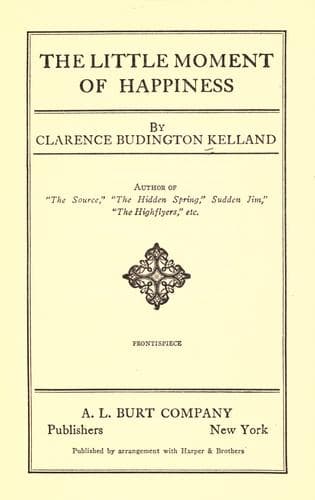
The Little Moment of HappinessKelland, Clarence Budington
General
The Little Moment of Happiness
Kelland, Clarence Budington
Man-woman relationships -- Fiction; World War, 1914-1918 -- Fiction
Then came the 18th, which dawned as other days dawn, with the same sun
rising in the east, with the same blue skies above, and the same breezes
moving over the surface of the same earth. But it was a day not like
other days. History may well set it down as the Day of Days, for it
marked the beginning of the end, the first note of the finale of the
crashing, discordant Germanic opera.... The Allies had counterattacked,
and fear was dead. That was the significant thing. The 18th of July,
A.D., 1918, marked the death of fear in the heart of Paris. From that
date onward there would be no news but good news. Terror of the Hun had
become a thing which one remembered but would no more experience.
The Élysées Palace Hôtel knew by night that our First and Second
divisions had struck at the base of the German salient about Reims and
that our Twenty-sixth Division had battered the apex before
Château-Thierry—and at last the American Expeditionary Force was in the
war. The Americans had come! The Americans were ready! The Americans had
started! Number 10 rue Ste.-Anne knew these things, as did the American
censorship high up in the Bourse. It was a day of exultation for
Americans in Paris....
In spite of censorships, in spite of military secrecy, in spite of
minute precautions, rumors circulate through armies which have an
undeniable basis of fact. On the 4th of July Kendall heard the soldiers
of the First Division stating confidently that they would march through
Paris streets on Bastille Day. No one had told them. Nobody knew how the
rumor earned its life, but it was there, and the event proved its
reliability. So an army rumor receives a degree of belief which does not
seem to be warranted. Rumors were a plentiful harvest now; big rumors
and little rumors ... and among them, circulating through the officers
of the Intelligence Department in Paris, was the whisper that some
officer or officers were to be sent back to America either on a mission
or to undertake permanent work.
Public-domain text, read in full here on John Shaqi.
Reviews
Reviews
No reviews yet
Be the first to share your thoughts on this work.
Elsewhere in the archive
Join the Discussion
Join the discussion
Sign in to leave a comment or review.
Sign InorCreate an account